
System visuals
What It Is
Industrial automation coordinates sensors, actuators, drives, machines and process equipment through defined sequences, permissives, interlocks and operator interfaces. Engineering begins with the process and safety intent, then selects controls and communications that can be maintained over the plant lifecycle.
Applications and Operating Objectives
Applications include new production lines, utilities, material handling, batch and continuous processes, machine integration, control upgrades, recipe execution, alarm rationalization and coordinated start-up/shutdown.
System Workflow and Architecture
Main Equipment and Software Components
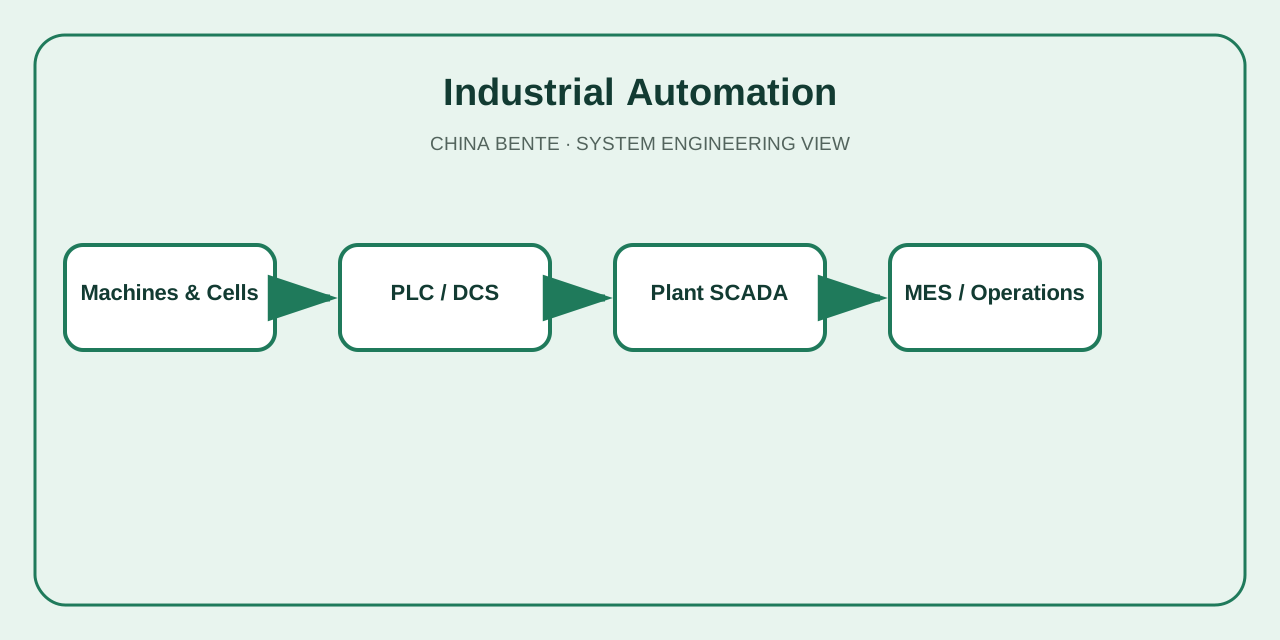
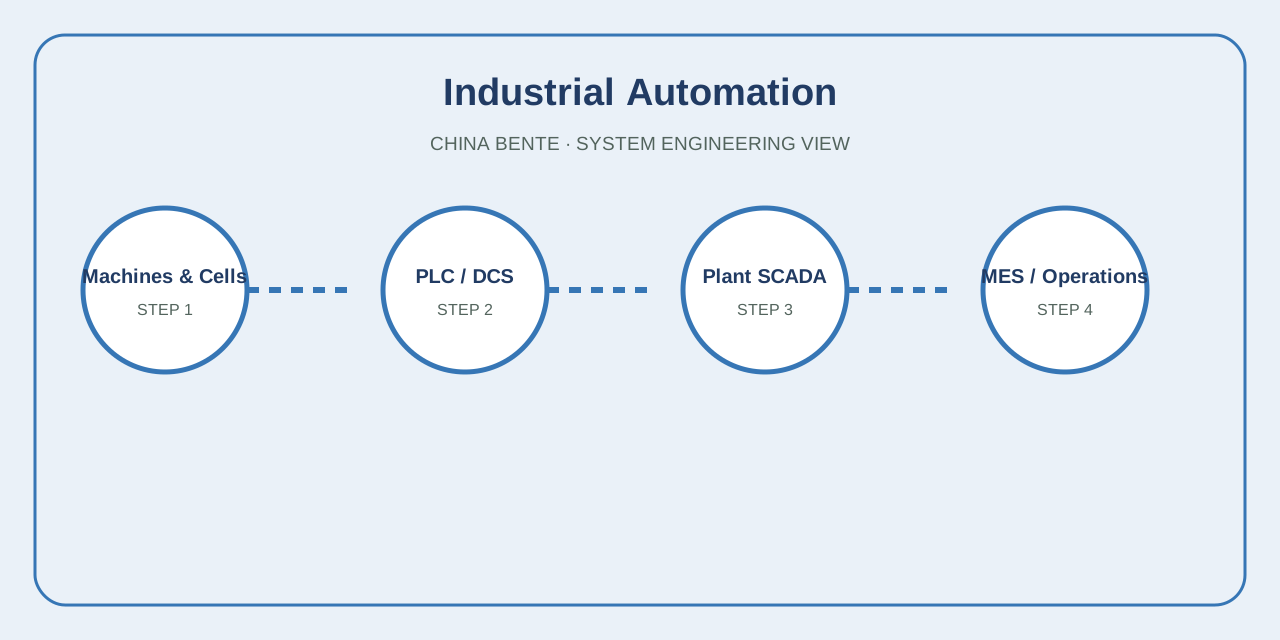
Scope may include instruments, remote I/O, control panels, PLC/DCS, VFD/servo systems, safety controllers, HMI/SCADA, industrial networks, historians and interfaces to package machines.
Safety functions are separated and validated to the required standard. Network, control ownership and command arbitration prevent conflicting control between packages.
Capacity and Design Basis
Design uses process narratives, P&IDs, equipment lists, I/O count and type, sequence timing, failure modes, environmental conditions and required maintainability.
| Operational scale | I/O and device counts, scan/time requirements, sequence complexity, redundancy, network nodes, operator stations and spare capacity are verified. |
|---|---|
| Interfaces | Hardwired and protocol interfaces identify command/status ownership, heartbeat, quality, timestamps, timeout and fail-safe state. |
| Performance basis | Acceptance verifies I/O, sequences, interlocks, alarms, mode transitions, recovery, cycle behavior and documentation against approved test procedures. |
| Unknown/TBC | Unverified tag counts, cycle times, accuracy, latency, availability, savings and integration scope remain TBC until discovery and testing. |
Utilities and Infrastructure
Power and UPS, panels and cooling, instrument air, cable containment, earthing, network/fiber, server resources and environmental ratings are coordinated.
Required Customer Engineering Inputs
Required inputs include P&IDs, process narratives, equipment and instrument lists, package protocols, electrical drawings, cause-and-effect, alarm philosophy, site standards and shutdown constraints.
Data, Automation and Control
Software uses structured modules, state models, permissive/interlock separation, diagnostic alarms and traceable revisions. Manual control cannot defeat required safety logic.
Cybersecurity and Access Control
Engineering access, removable media, remote support, backups, account control, network zoning and patch strategy follow owner policy and plant risk.
CAPEX and OPEX Drivers
Drivers include I/O, panels, instruments, drive/motion scope, redundancy, package interfaces, software/testing effort and shutdown commissioning. OPEX includes spares, licenses, backups, support and obsolescence management.
Safety, Compliance and Lifecycle
Hazard and operability findings, machine safety, emergency stop, safe states and proof tests are incorporated without claiming an undefined safety integrity level.
Outputs and Acceptance Basis
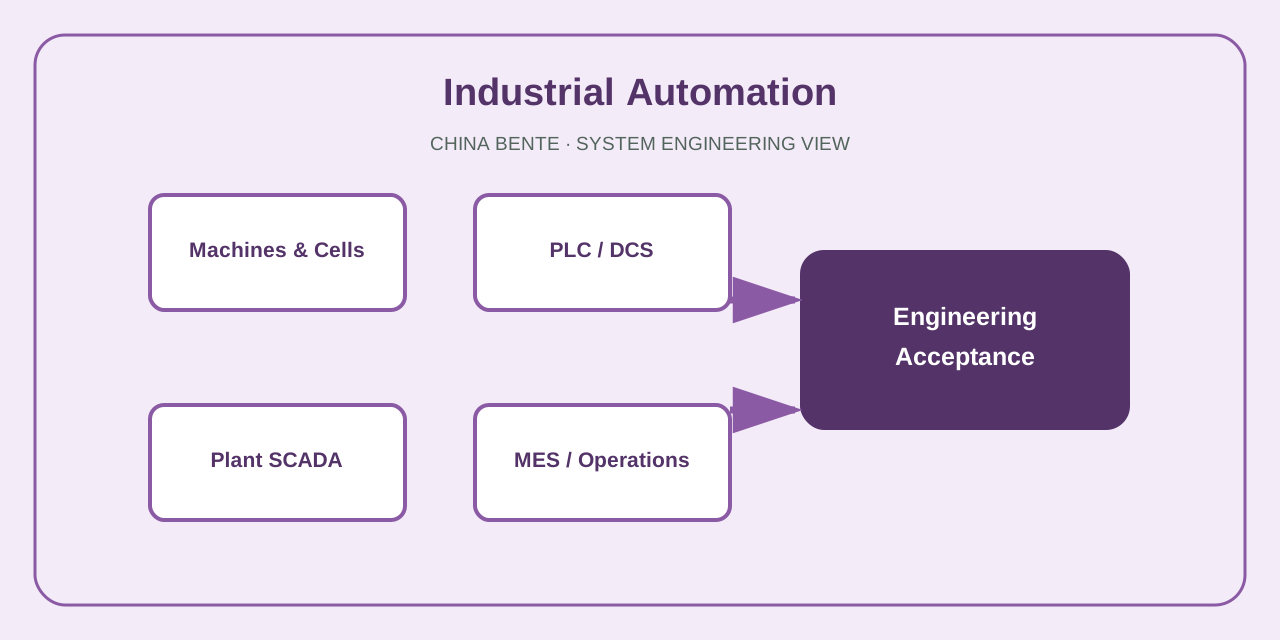
Deliverables include approved logic and HMI, tested I/O and sequences, alarm/interlock records, source and backups, as-built drawings, manuals, training and signed FAT/SAT results.
Implementation and Commissioning
Execution follows design freeze, hardware build, software simulation, FAT, installation, loop checks, no-load and load commissioning, performance observation and formal handover.
Project Evidence
No production gain, accuracy, uptime or savings figure is claimed without approved evidence. Any reference used during evaluation will identify its scope and verification status. This page uses a system architecture diagram and does not present a concept image as a completed client project.
Frequently Asked Questions
PLC or DCS: which is required?
Selection depends on process type, scale, availability, redundancy, batch/control needs and owner standards.
Can automation be commissioned without stopping production?
Some interfaces can be prepared online, but safe cutover and final testing require an approved shutdown or staged plan.
How are package machines integrated?
An interface specification defines commands, states, alarms, ownership, timeout and fail behavior.
Are safety interlocks part of the normal PLC?
Only when risk assessment and applicable standards permit; safety functions may require a dedicated certified system.
How is software quality controlled?
With standards, modular design, peer review, simulation, version control and traceable FAT/SAT tests.
What happens if communications fail?
Each interface has an agreed timeout, safe state, local operating capability and recovery sequence.
Will cycle time improve?
Any improvement depends on verified constraints and testing; no generic gain is promised.
What must be handed over?
Source code, compiled backups, licenses, passwords under owner control, drawings, I/O and test records, manuals and training.
Related Engineering Links
Smart & Intelligent Solutions overview · AI Vision Inspection · Digital Twin & Data Platform · Projects & Cases · Request a Project Evaluation
Request a Project Evaluation
Provide process narratives, I/O or tag lists, network and system inventory, production objectives, existing backups, data interfaces, cybersecurity rules and acceptance priorities. Unknown information may remain TBC.