
System visuals
What It Is
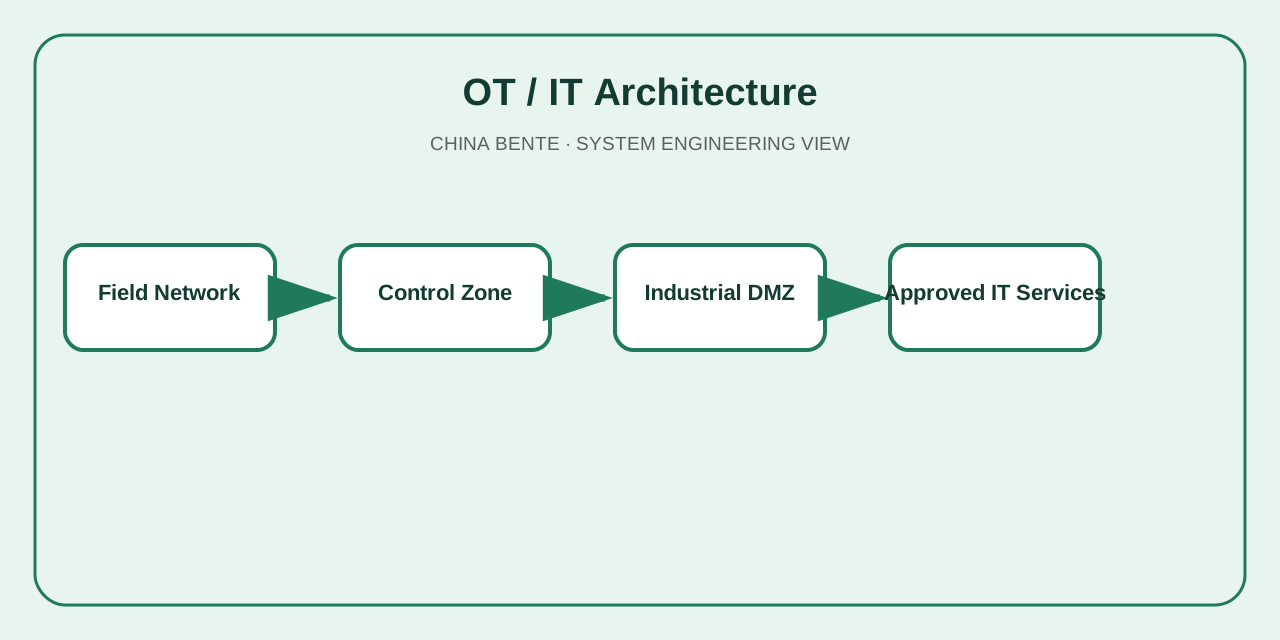
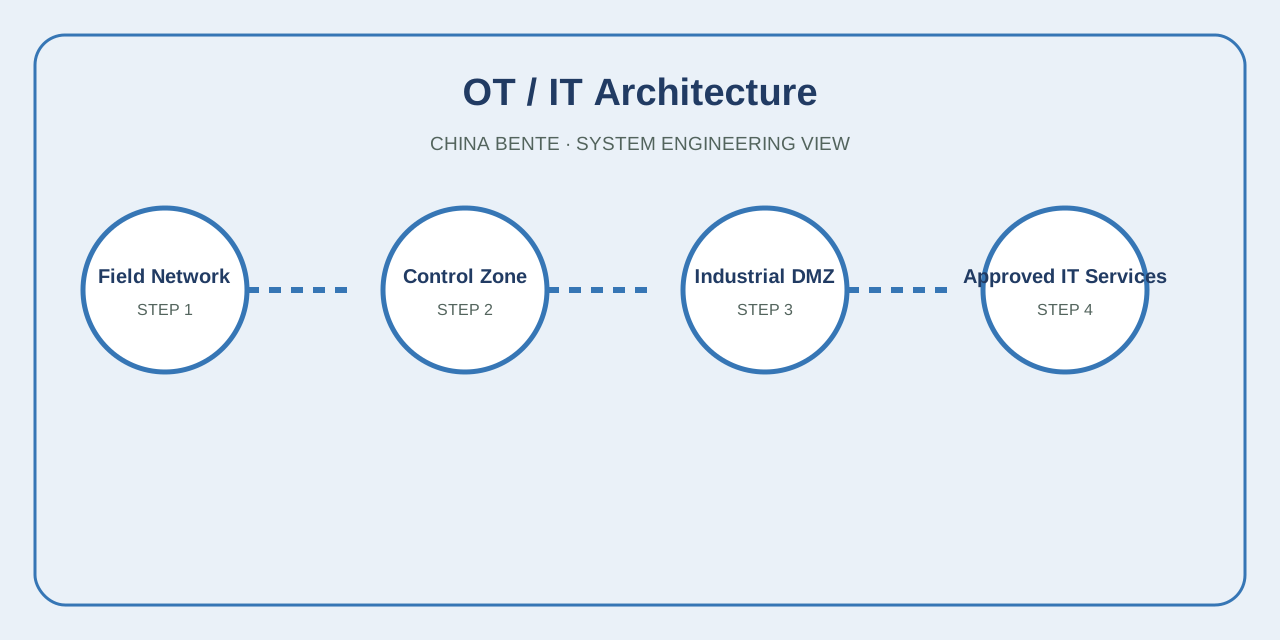
OT/IT network architecture defines how control systems, industrial devices, servers and enterprise applications communicate while preserving safety, availability, security and ownership. It documents zones, conduits, protocols, addressing, redundancy, time and support rather than connecting plants through an unmanaged flat network.
Applications and Operating Objectives
Applications include new factories, control upgrades, plant/enterprise integration, remote sites, multi-vendor package integration, historian/MES connectivity, wireless industrial networks and network remediation.
System Workflow and Architecture
The design applies least required connectivity between documented zones, with industrial DMZ for controlled exchange. Safety and real-time paths avoid dependencies that cannot meet their availability or latency needs.
Main Equipment and Software Components
Components may include industrial switches, routers, firewalls, fiber/copper/wireless, network-management system, time servers, jump hosts, remote-access gateway, logging, UPS and cabinet/environmental systems.
Capacity and Design Basis
Design uses asset and port inventory, protocol and multicast behavior, bandwidth/latency, availability, redundancy, environmental rating, distance, expansion, cybersecurity and support skills.
| Operational scale | Nodes, ports, uplinks, traffic normal/burst, broadcast domains, fiber strands, wireless clients, logs and future margin are quantified. |
|---|---|
| Interfaces | Control, safety, SCADA, historian, MES, vendor packages, identity, logging, backup and enterprise systems have documented connections and failure behavior. |
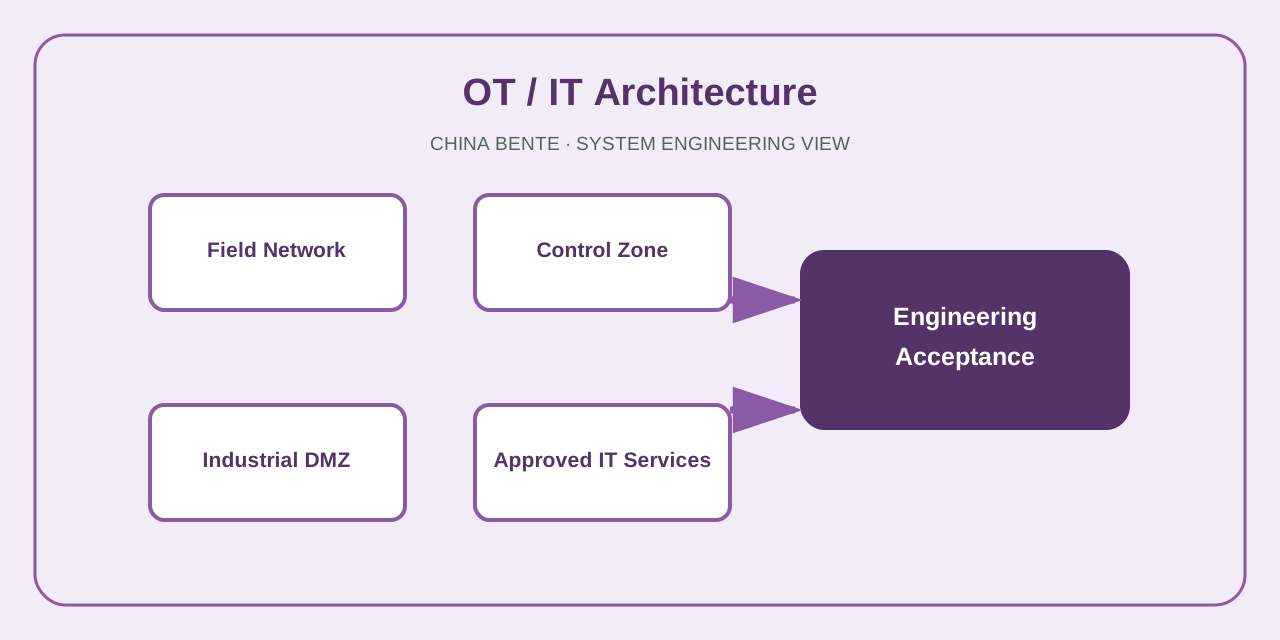
| Acceptance performance | Acceptance covers topology and addressing, link and protocol tests, latency where critical, redundancy/failover, rule validation, time sync, logging, backup and recovery. |
| Unknown/TBC | Unverified counts, latency, accuracy, availability, savings and integration assumptions remain TBC until survey and testing. |
Utilities and Infrastructure
Cabinets, power/UPS, grounding, cooling, fiber routes, hazardous/environmental ratings, secure rooms, wireless survey and spare parts are included.
Required Customer Engineering Inputs
Customers provide asset/network inventory, current drawings/configurations, protocols, criticality, user/vendor access, cybersecurity policy, physical routes, expansion and shutdown constraints.
Data, Automation and Control
Network management monitors link/device health and configuration changes without issuing process commands. Time, multicast and quality-of-service are engineered for actual industrial protocols.
Cybersecurity and Access Control
Segmentation, allow-listed rules, identity, jump/remote access, logging, backups, patch process and incident isolation are aligned with risk and owner policy.
CAPEX and OPEX Drivers
CAPEX depends on fiber/civil routes, redundancy, switch/firewall count, remediation and migration. OPEX includes support, licenses, configuration backup, monitoring, spares and refresh.
Safety, Compliance and Lifecycle
Network change cannot bypass plant safety. Migration plans preserve critical communications and define rollback, degraded operation and emergency contacts.
Outputs and Acceptance Basis
Deliverables include asset/port inventory, logical/physical diagrams, addressing/VLAN/routing and firewall rules, configurations/backups, failover tests, monitoring, manuals and training.
Implementation and Commissioning
Work proceeds through passive/approved discovery, architecture and rule review, lab or offline configuration, staged installation, controlled cutover, protocol/failover tests and as-built handover.
Project Evidence
Frequently Asked Questions
Why not use one flat plant network?
It increases fault and security propagation and makes ownership and troubleshooting harder.
Does segmentation stop production traffic?
No when rules and architecture are designed and tested for required protocols and availability.
What is an industrial DMZ?
A controlled zone that mediates data exchange and services between OT and enterprise networks.
Can office Wi-Fi be used for controls?
Only if engineering shows availability, latency, security and ownership meet the specific non-safety use; critical control usually needs dedicated design.
How is vendor remote access handled?
Through approved identity, time-bounded authorization, secure gateway, logging and owner oversight.
What if existing configurations are unavailable?
Read-only discovery and device backup are performed before a controlled migration plan is approved.
How is redundancy tested?
By approved link/device/power failure scenarios while monitoring recovery and process impact.
What must be handed over?
As-built topology, asset/port list, addressing, rules, device configurations, licenses, backups, tests and governance.
Related Engineering Links
Smart & Intelligent Solutions overview · AI Vision Inspection · Digital Twin & Data Platform · Projects & Cases · Request a Project Evaluation
Request a Project Evaluation
Provide system inventory, network and control drawings, data samples, user and security requirements, existing backups, operational constraints and acceptance priorities. Unknown information may remain TBC.