
System visuals
What It Is
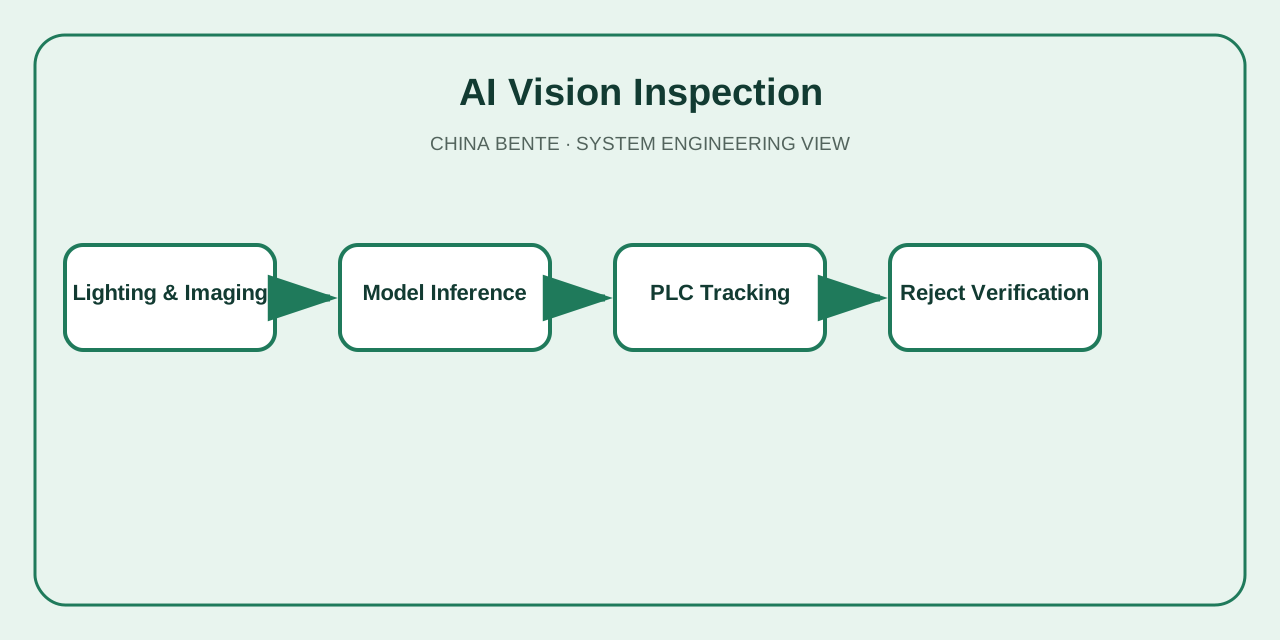
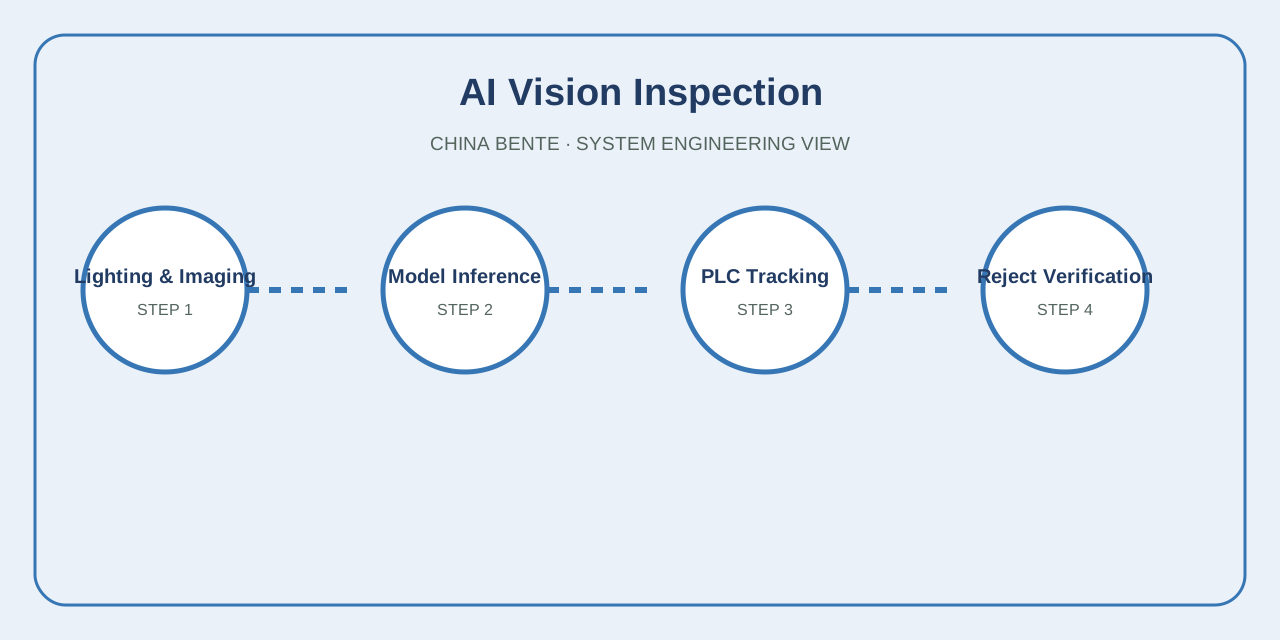
AI vision inspection uses controlled imaging and algorithms to detect, classify, locate or measure defined product features or defects. A production system requires stable presentation, optics and lighting, representative labeled data, traceable decisions, reject verification and a plan for model drift and new products.
Applications and Operating Objectives
Applications include surface defect detection, assembly verification, presence/absence, OCR and code reading, dimensional checks, sorting, foreign-object detection, packaging inspection and operator-assistance workflows.
System Workflow and Architecture
Main Equipment and Software Components
Components may include industrial cameras, lenses, lighting, enclosures, triggers, edge computer or smart camera, model/runtime, PLC interface, reject device, verification sensors, image storage and review station.
Deterministic machine control remains in PLC/safety layers. Vision returns a result with confidence and quality flags; timeout, invalid image and unavailable-model states follow explicit fail behavior.
Capacity and Design Basis
Design uses feature/defect definition, minimum size and contrast, line speed, field of view, presentation tolerance, product variants, environmental conditions, error consequences and data retention.
| Operational scale | Inspection frequency, image size, inference latency, simultaneous cameras, storage, product recipes and review workload are calculated. |
|---|---|
| Interfaces | Trigger, encoder, product ID, result, confidence, reject tracking, audit image and host quality records use a defined handshake. |
| Performance basis | Acceptance reports class-specific precision/recall or false accept/reject on an agreed blind set and representative line conditions; a single accuracy headline is not sufficient. |
| Unknown/TBC | Unverified tag counts, cycle times, accuracy, latency, availability, savings and integration scope remain TBC until discovery and testing. |
Utilities and Infrastructure
Stable mounting, controlled lighting, clean air or cooling, power/UPS, network/storage, reject mechanics, guarding, access for cleaning and calibration are required.
Required Customer Engineering Inputs
Customers provide defect standards, good and bad samples, product variants, line speed/layout, reject method, traceability needs, consequence of errors, environmental conditions and quality procedures.
Data, Automation and Control
Image quality checks detect blur, occlusion, lighting change and missing trigger. Model, recipe and threshold versions are logged with each decision where required.
Cybersecurity and Access Control
Training and production data access, model files, software updates, remote support, backups and retention follow owner policy; sensitive images are not sent externally without authorization.
CAPEX and OPEX Drivers
CAPEX depends on imaging complexity, cameras, mechanics, data collection/labeling, integration and validation. OPEX includes cleaning/calibration, model review, new-product data, storage, licenses and support.
Safety, Compliance and Lifecycle
Reject devices, moving parts, strobes/lasers where used, access and maintenance are risk assessed. AI does not replace required safety functions.
Outputs and Acceptance Basis
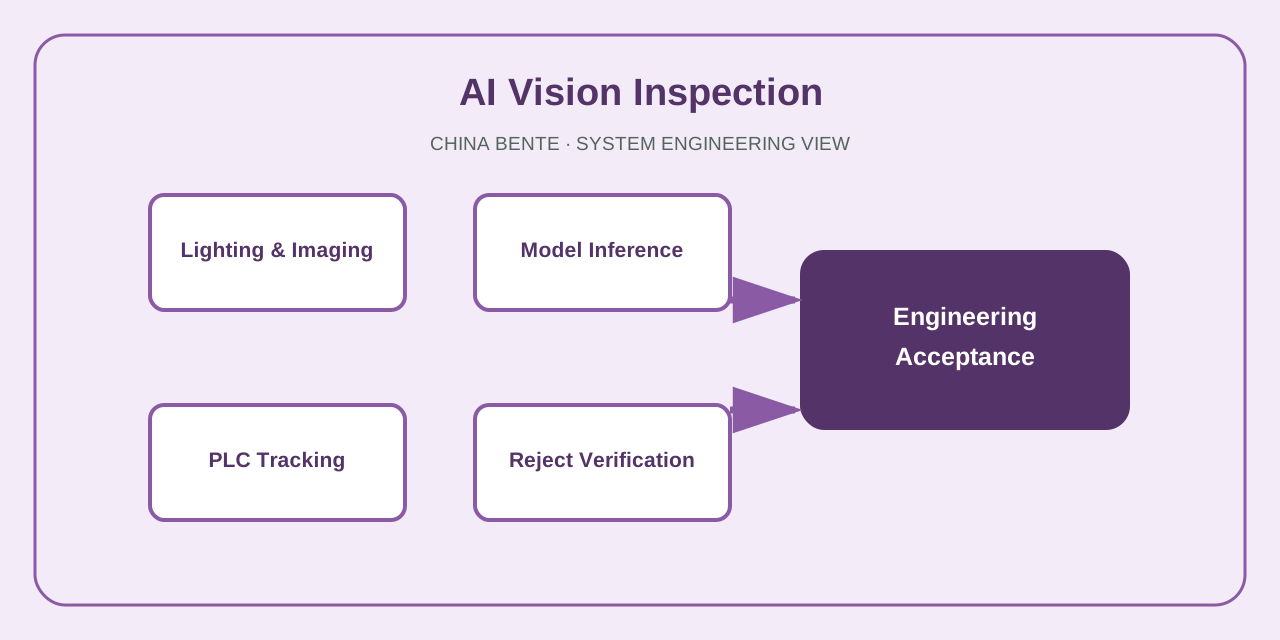
Outputs include inspection specification, imaging setup, labeled/validation dataset records, versioned model, PLC handshake, reject verification, performance report by class, source/configuration, training and rollback procedure.
Implementation and Commissioning
Delivery follows feasibility imaging, data plan, prototype, offline evaluation, cell build, FAT, controlled shadow mode, blind production validation, approved cutover and monitored stabilization.
Project Evidence
No production gain, accuracy, uptime or savings figure is claimed without approved evidence. Any reference used during evaluation will identify its scope and verification status. This page uses a system architecture diagram and does not present a concept image as a completed client project.
Frequently Asked Questions
How much training data is required?
It depends on defect diversity, product variants, imaging stability and required error confidence; a universal count is not valid.
Can AI find defects never shown before?
Some anomaly methods can flag differences, but production acceptance still needs defined risk, samples and validation.
What is a false accept?
A defective item incorrectly classified as acceptable; its consequence helps determine thresholds and redundancy.
Why is lighting important?
Stable contrast and reflection often determine image quality more than the algorithm and must be engineered.
Can the model control the reject directly?
The result normally passes through PLC tracking and verified reject logic with timeout and failure handling.
How is model drift managed?
Image-quality and result trends, reviewed samples, change control, retraining criteria and rollback are defined.
Is 99% accuracy enough?
A single overall figure can hide critical class errors; acceptance must be defect-specific on representative blind data.
What starts a feasibility study?
Defect definitions, representative good/bad samples, product variants, line speed, presentation and error consequences.
Related Engineering Links
Smart & Intelligent Solutions overview · Digital Twin & Data Platform · Energy Monitoring & Management · Projects & Cases · Request a Project Evaluation
Request a Project Evaluation
Provide process narratives, I/O or tag lists, network and system inventory, production objectives, existing backups, data interfaces, cybersecurity rules and acceptance priorities. Unknown information may remain TBC.