
System visuals
What It Is
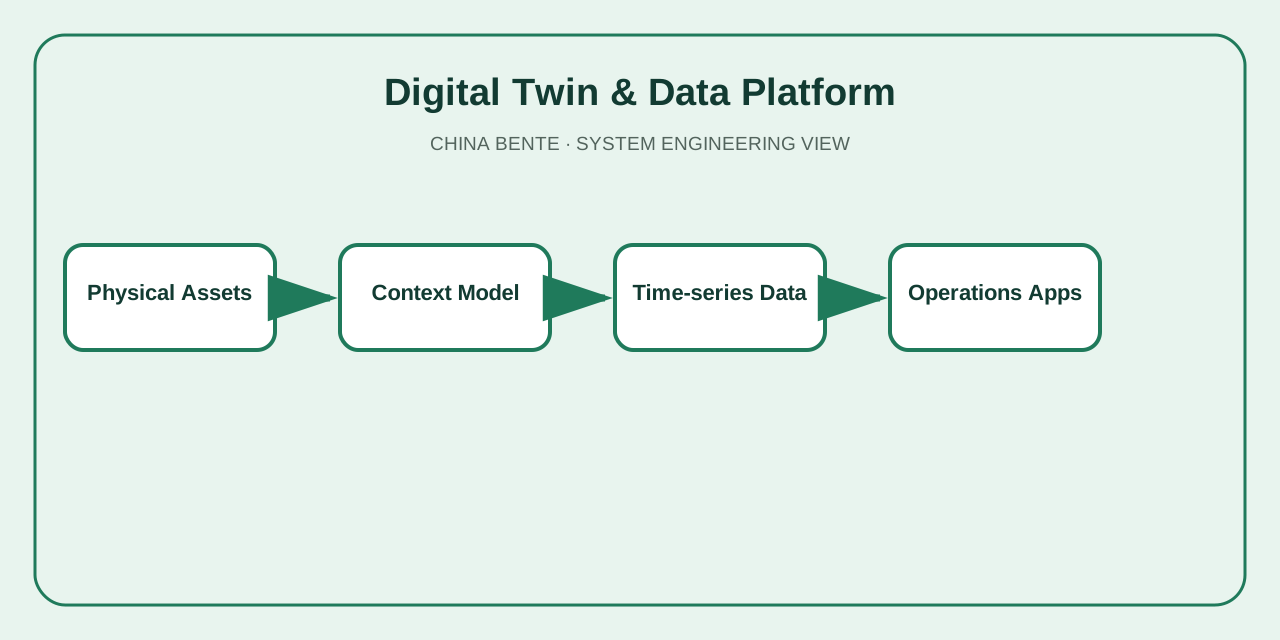
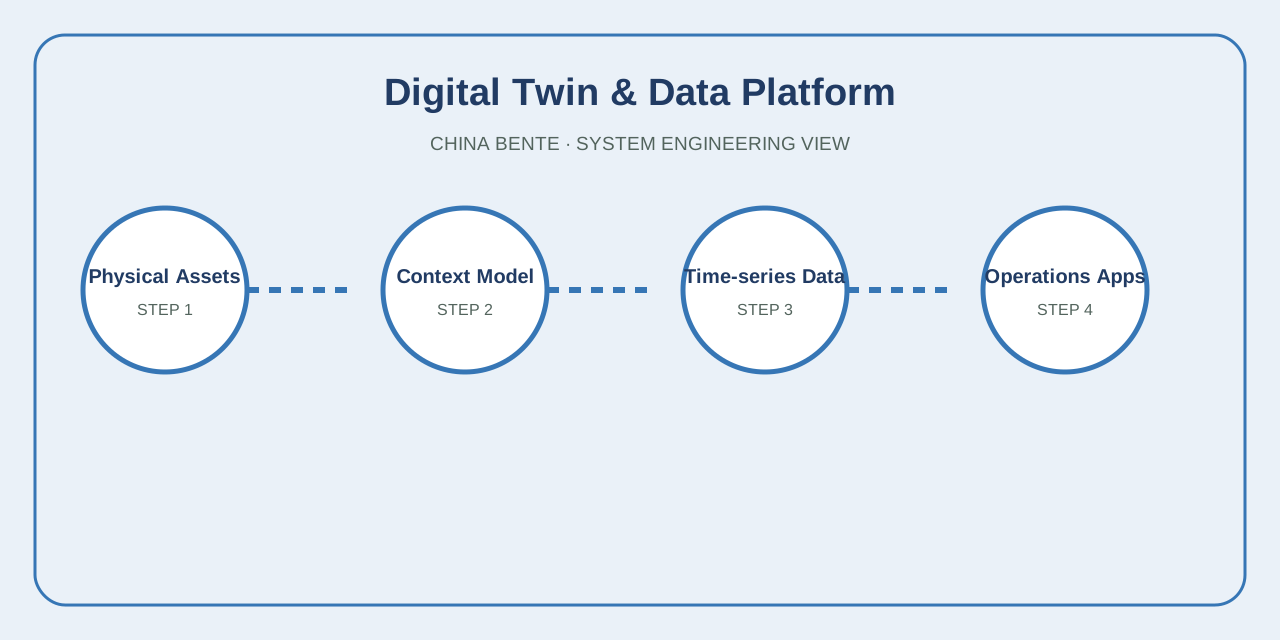
An industrial digital twin combines an asset model with current and historical data, engineering context and validated calculations or simulations. The supporting data platform ingests, governs and serves information to authorized applications without pretending that a visualization alone is a twin.
Applications and Operating Objectives
Use cases include asset and process context, operational dashboards, what-if analysis, performance reconciliation, maintenance support, energy and material balances, commissioning records and multi-site data products.
System Workflow and Architecture
Architecture separates source systems, ingestion, storage, contextual model, analytics and applications. Every derived value identifies source, time, quality and model version.
Main Equipment and Software Components
Components may include edge connectors, historian and event stores, data lake or time-series database, asset/semantic model, calculation services, APIs, dashboards, identity, catalog, quality and backup tools.
Capacity and Design Basis
Design uses prioritized use cases, asset scope, data sources and rates, model fidelity, update frequency, retention, users, validation and deployment constraints.
| Operational scale | Assets, tags/events, engineering documents, data rate, history, calculations, API calls, users and site expansion are quantified. |
|---|---|
| Interfaces | PLC/SCADA/historian, MES, ERP, CMMS, laboratory, GIS/BIM and document systems retain clear ownership and governed interfaces. |
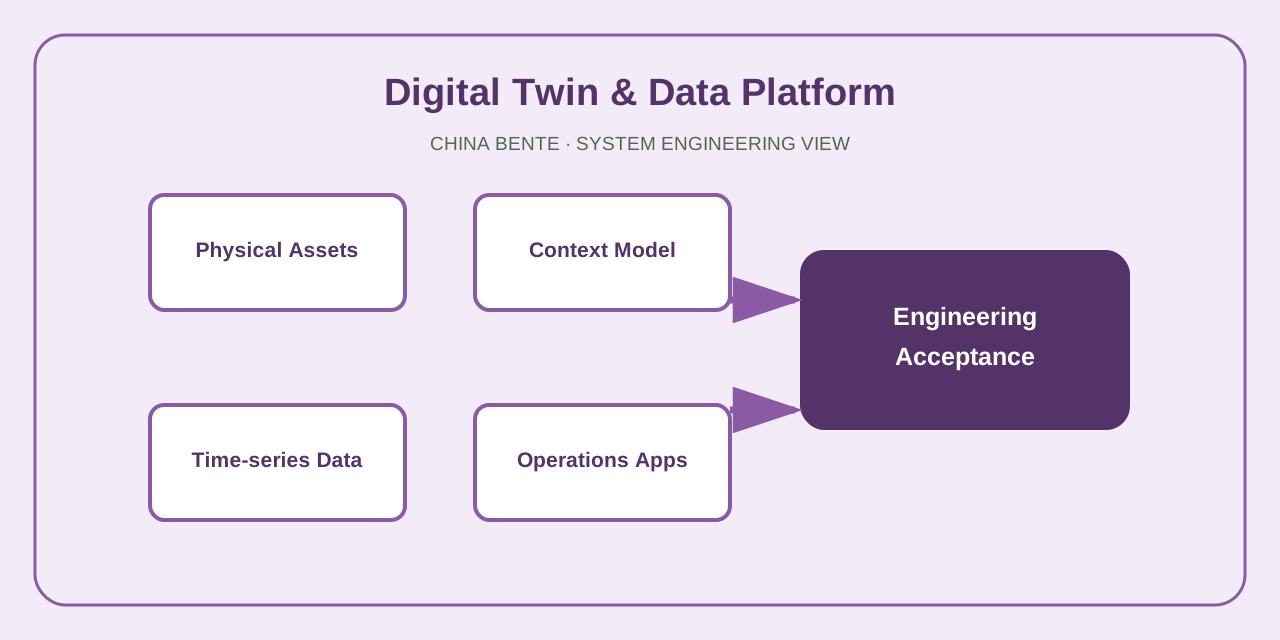
| Acceptance performance | Acceptance covers data completeness and quality, semantic mapping, calculation validation, latency, role access, API behavior, lineage, backup and recovery. |
| Unknown/TBC | Unverified counts, latency, accuracy, availability, savings and integration assumptions remain TBC until survey and testing. |
Utilities and Infrastructure
Edge compute, on-premise or cloud resources, storage, network, time service, test environment, monitoring, backup and disaster recovery are evaluated.
Required Customer Engineering Inputs
Customers provide use cases, asset hierarchy, tag lists and samples, engineering models/documents, source-system owners, quality/retention rules, user roles and validation data.
Data, Automation and Control
The platform preserves source quality flags and does not silently fill UNKNOWN values. Any control recommendation remains advisory or passes through a separately validated control interface.
Cybersecurity and Access Control
Data zones, identity, API authorization, encryption, logging, supplier access, tenant separation, data residency, backups and model/software supply chain are governed.
CAPEX and OPEX Drivers
CAPEX depends on integration, data cleanup, model complexity, validation and applications. OPEX includes compute/storage, licenses, data stewardship, model maintenance, security and support.
Safety, Compliance and Lifecycle
Model outputs include limits and uncertainty and cannot override protection. Lifecycle controls prevent stale models or wrong asset context from guiding operations.
Outputs and Acceptance Basis
Deliverables include architecture, asset/semantic model, source interfaces, validated calculations, data-quality rules, applications/APIs, lineage, backups, governance, training and recovery procedures.
Implementation and Commissioning
Execution uses a bounded use-case pilot, source and quality assessment, model build, validation with historical/live data, user acceptance, controlled release and monitored expansion.
Project Evidence
Frequently Asked Questions
Is a 3D model a digital twin?
Not by itself. A twin needs governed asset context, live or historical data and validated behavior for a defined use case.
Must all plant data be copied?
No. Only data needed for approved use cases and governance should be integrated.
How is model accuracy managed?
Through defined validation data, error metrics, operating envelope, versioning and drift review.
Can the twin control equipment?
Only through a separately engineered and validated control interface; most twins are advisory.
How are UNKNOWN values handled?
They remain explicitly unknown or poor quality rather than being silently invented.
Cloud or on premises?
The choice follows latency, availability, security, data residency, integration and lifecycle needs.
Who owns the semantic model?
The owner should govern hierarchy, naming, units and change control with domain and data specialists.
What proves value?
Use-case acceptance and measured operational outcomes, not the number of connected tags or visualizations.
Related Engineering Links
Smart & Intelligent Solutions overview · AI Vision Inspection · Energy Monitoring & Management · Projects & Cases · Request a Project Evaluation
Request a Project Evaluation
Provide system inventory, network and control drawings, data samples, user and security requirements, existing backups, operational constraints and acceptance priorities. Unknown information may remain TBC.