
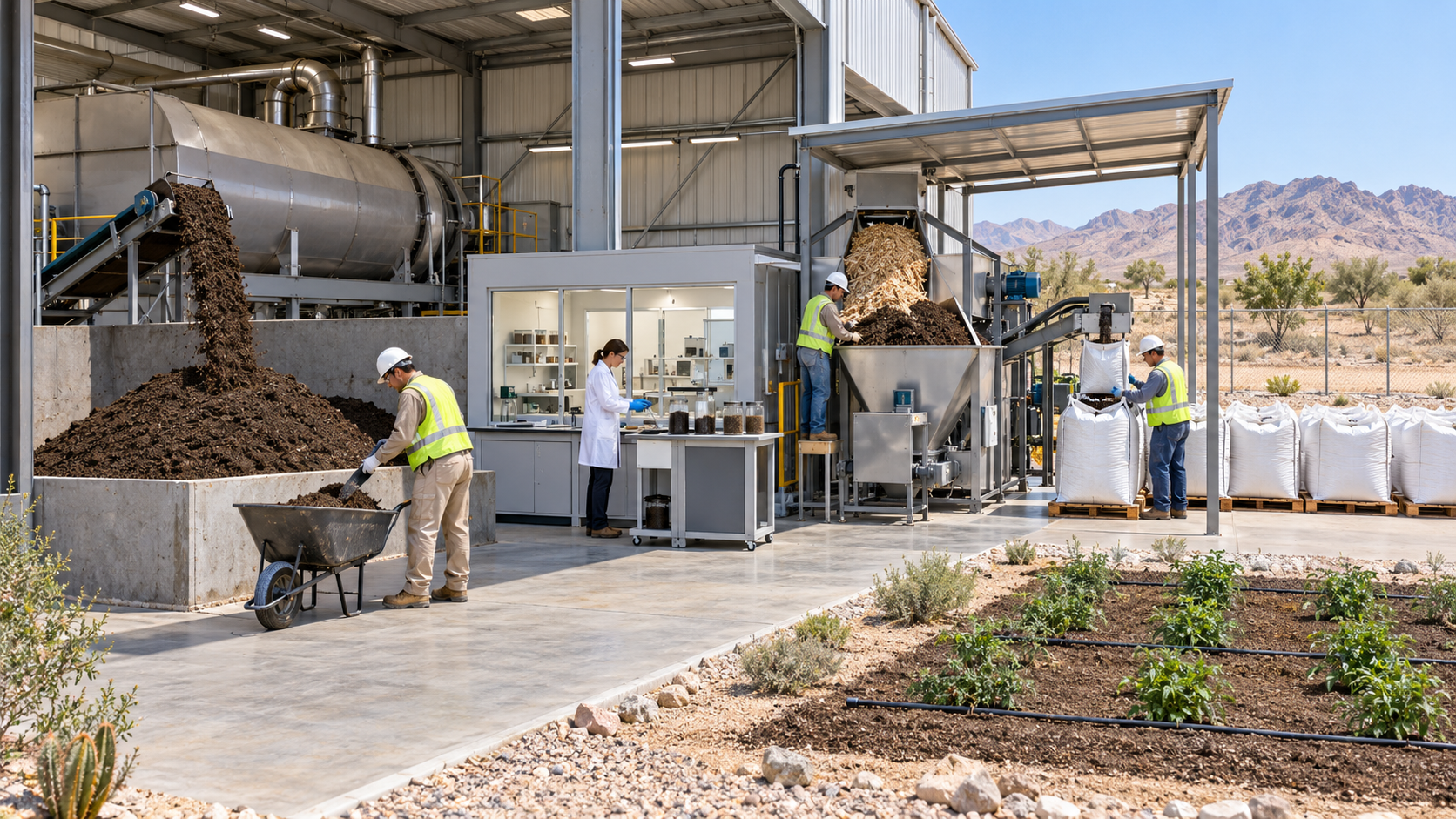
A conditional beneficial-use route for suitably stabilized and tested municipal sludge solids, subject to contaminant limits, soil trials and local approval.
Process Flow
- 1. Representative sludge characterization
- 2. Dewatering and controlled drying
- 3. Stabilization and pathogen control
- 4. Blend formulation with mineral or agricultural amendments
- 5. Laboratory and controlled pilot testing
- 6. Approved application with monitoring
Main Equipment
- Dewatering and indirect drying systems
- Enclosed mixing and dosing equipment
- Sampling and laboratory instruments
- Bagging or controlled bulk-loading system
Utilities and Environmental Interfaces
Power, thermal energy, ventilation, water and laboratory support depend on the selected drying and formulation route.
This is not a default disposal route. Metals, persistent contaminants, pathogens, salinity, leaching and local land-application limits must be verified before use.
Customer Inputs Required
Full sludge analysis, treatment history, target soil data, climate, intended crop/land use, local standards and an approved pilot-test plan.
EPC Delivery Scope
Concept and feasibility alignment, process and layout engineering, equipment integration, procurement coordination, installation supervision, commissioning support, operator training and handover documentation. Final battery limits are confirmed in the project proposal.
Frequently Asked Questions
What information is required to define a Municipal Sewage Sludge to Desert Soil Amendment project?
Target products, capacity, raw-material specification, site conditions, utilities, local codes and desired automation level are required before concept engineering.
Can the Municipal Sewage Sludge to Desert Soil Amendment plant be configured in phases?
Yes. The layout and utility backbone can be planned for staged capacity, subject to site and process constraints.
How is the sludge treatment process selected?
Selection is based on feed and product specifications, capacity, energy balance, environmental requirements and lifecycle cost.
Which utilities must the customer confirm for Municipal Sewage Sludge to Desert Soil Amendment?
Available electricity, water, fuel, steam or thermal oil, compressed air, drainage and communications should be confirmed for the selected process.
Which environmental controls apply to Municipal Sewage Sludge to Desert Soil Amendment?
Collection and treatment interfaces for dust, fumes, wastewater, noise and solid residues are defined according to the process and applicable local standards.
What is included in Municipal Sewage Sludge to Desert Soil Amendment commissioning?
Commissioning scope can include dry tests, utility checks, interlock tests, trial production, performance verification and operator training.
Can local equipment and civil contractors be integrated into Municipal Sewage Sludge to Desert Soil Amendment?
Yes. A responsibility matrix can divide imported packages, locally sourced equipment, civil works and installation while preserving interface control.
How are Municipal Sewage Sludge to Desert Soil Amendment schedule and performance guarantees finalized?
They are set only after feed data, product specification, battery limits, site inputs and acceptance criteria are jointly confirmed.