
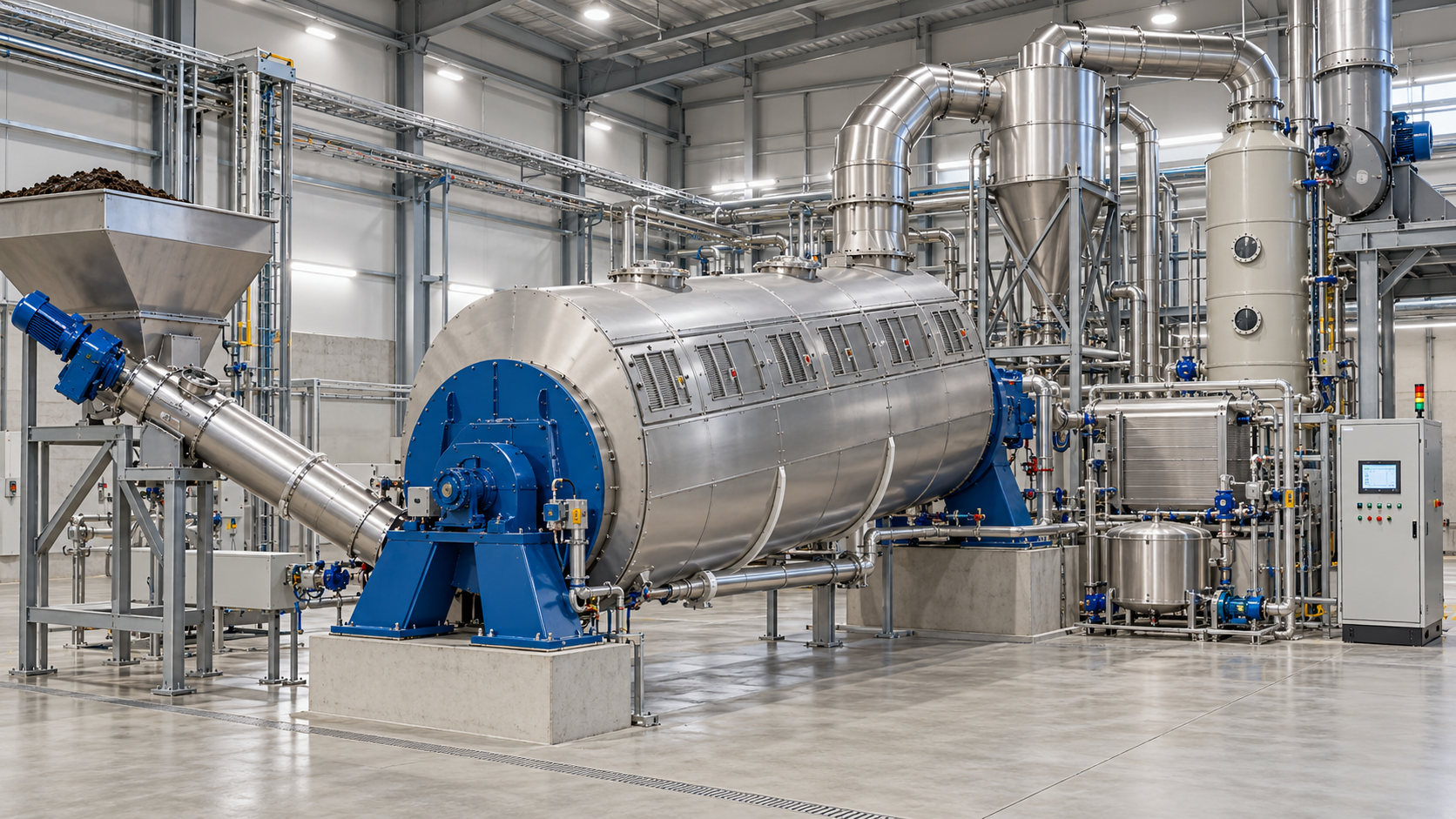
A controlled route for dewatering and indirectly drying municipal sewage sludge before testing, optional agricultural-residue blending, and production of RDF, fuel briquettes or carbon rods.
Confirmed process route
This route starts with municipal sewage sludge. The sludge is thickened and mechanically dewatered, then dried in an enclosed indirect steam-heated disc dryer. The dried material is tested before any fuel recipe is selected. Qualified agricultural residues may be added only where testing supports the blend. The conditioned material can then be prepared as RDF, fuel briquettes or carbon rods for a specifically permitted thermal-use facility.
Process flow
Indirect disc-dryer system
The dryer uses hollow rotating discs and a heated rotor to transfer steam energy indirectly into the sludge. Enclosed screw conveyors manage feed and discharge. Generated vapour leaves through the dryer vapour dome for solids separation and condensation, while steam condensate is returned or managed within the utility system according to the project design.
Main equipment and systems
- Thickening and mechanical dewatering
- Wet-sludge and recirculated-product mixing hopper
- Enclosed feed and discharge screw conveyors
- Indirect steam-heated disc dryer
- Dry-product diversion and controlled recirculation
- Cyclone or equivalent entrained-solids separation
- Process-vapour condenser
- Non-condensable-gas fan and chemical scrubber
- Grinding, recipe dosing and optional residue blending
- RDF handling, briquette or carbon-rod forming
- Dust collection and fire/explosion protection
- PLC/HMI, instrumentation and safety interlocks
Environmental and utility integration
Vapour collection, cyclone separation, condensation, non-condensable-gas extraction, odour treatment, condensate management and dust control are engineered as part of the line. The design basis also defines steam and condensate service, power, water, cooling, compressed air, drainage, fire protection and safe maintenance access.
Fuel qualification and acceptance
Final use is not assumed from drying alone. Representative samples must be checked for moisture, net calorific value, ash, chlorine, sulphur, heavy metals, particle behaviour, storage stability and combustion or emissions implications. Acceptance criteria are agreed with the permitted receiving facility and applicable regulators.
Control and safety philosophy
Typical control points include feed stability, dryer temperature and pressure, steam and condensate conditions, vapour extraction, discharge condition and downstream material handling. Interlocks, alarms, emergency shutdown, dust control, fire detection and explosion-risk measures are selected from the project hazard assessment.
Engineering boundary
Concept definition, laboratory and pilot-test coordination, mass and energy balances, equipment sizing, layout, utilities, environmental systems, procurement, civil interfaces, automation, installation support, FAT/SAT, commissioning, training and performance verification can be included within the agreed EPC scope. No supplier quotation value or project-specific capacity is presented as a general guarantee.
Frequently asked questions
Why is indirect disc drying used before RDF production?
Steam heats the hollow rotor and discs without directly mixing combustion gas with the sludge. This provides a compact heat-transfer surface and a controlled route for removing process vapour.
Is dried sewage sludge automatically suitable as RDF?
No. Moisture, net calorific value, ash, chlorine, sulphur, heavy metals, combustion behaviour and the receiving facility requirements must be verified before use.
When are agricultural residues added?
Only when representative testing and the selected fuel recipe justify blending to improve handling or fuel properties. The type and dosage are project-specific.
How are vapour and odour controlled?
The enclosed dryer vapour is collected and routed through solids separation and condensation. Non-condensable gas is drawn to an appropriate scrubber or other specified odour-control system.
What happens to dryer condensate?
Condensate quality is assessed and it is routed to the project wastewater-treatment system or another approved treatment and reuse route.
Can dry material be recirculated?
Where required by the feed behaviour, a controlled portion of dry product can be returned to the mixing stage to improve feed consistency and dryer operation.
What automation is included?
The design can include PLC/HMI control, feed and discharge interlocks, steam and condensate monitoring, temperature and pressure control, moisture-related operating logic, alarms and emergency shutdowns.
How are capacity and performance confirmed?
They are confirmed from representative sludge data, operating hours, inlet and target moisture, mass and energy balances, utilities, environmental limits and an agreed performance test protocol.