
.cbih-week1-visual{margin:28px 0}.cbih-week1-visual img{display:block;width:100%;height:auto;border-radius:12px}.cbih-week1-feature img{max-height:620px;object-fit:cover}
Waste Recycling
A buyer’s guide to choosing manual, mechanical and optical stages from the waste itself.
By China Bente Engineering Team · Published 26 October 2026
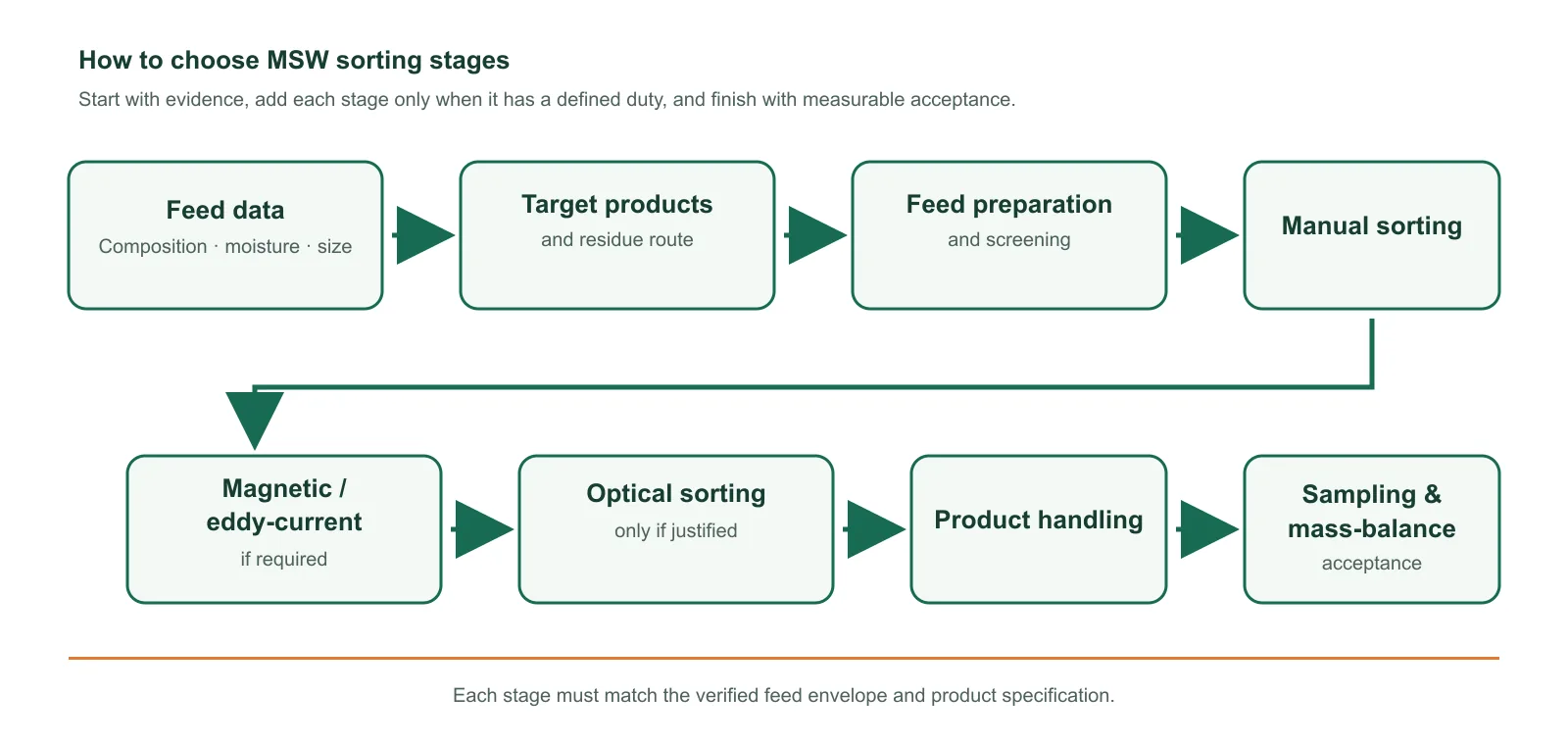
The right level depends on your waste composition and the products you must sell, not on a preferred machine. Manual sorting suits variable feed and quality control; mechanical stages such as screens, magnets and eddy-current separators handle size, ferrous and non-ferrous metals; optical sorting pays only when targets are detectable and the feed is presented in a controlled stream.
Choosing the automation level too early can produce either over-investment or a line that cannot meet its product specifications. Buyers first need a credible feed envelope, defined recovered products, a residue route and an acceptance method. Those inputs show where people add judgement, where mechanical separation adds consistency and whether sensor-based sorting has a justified duty.
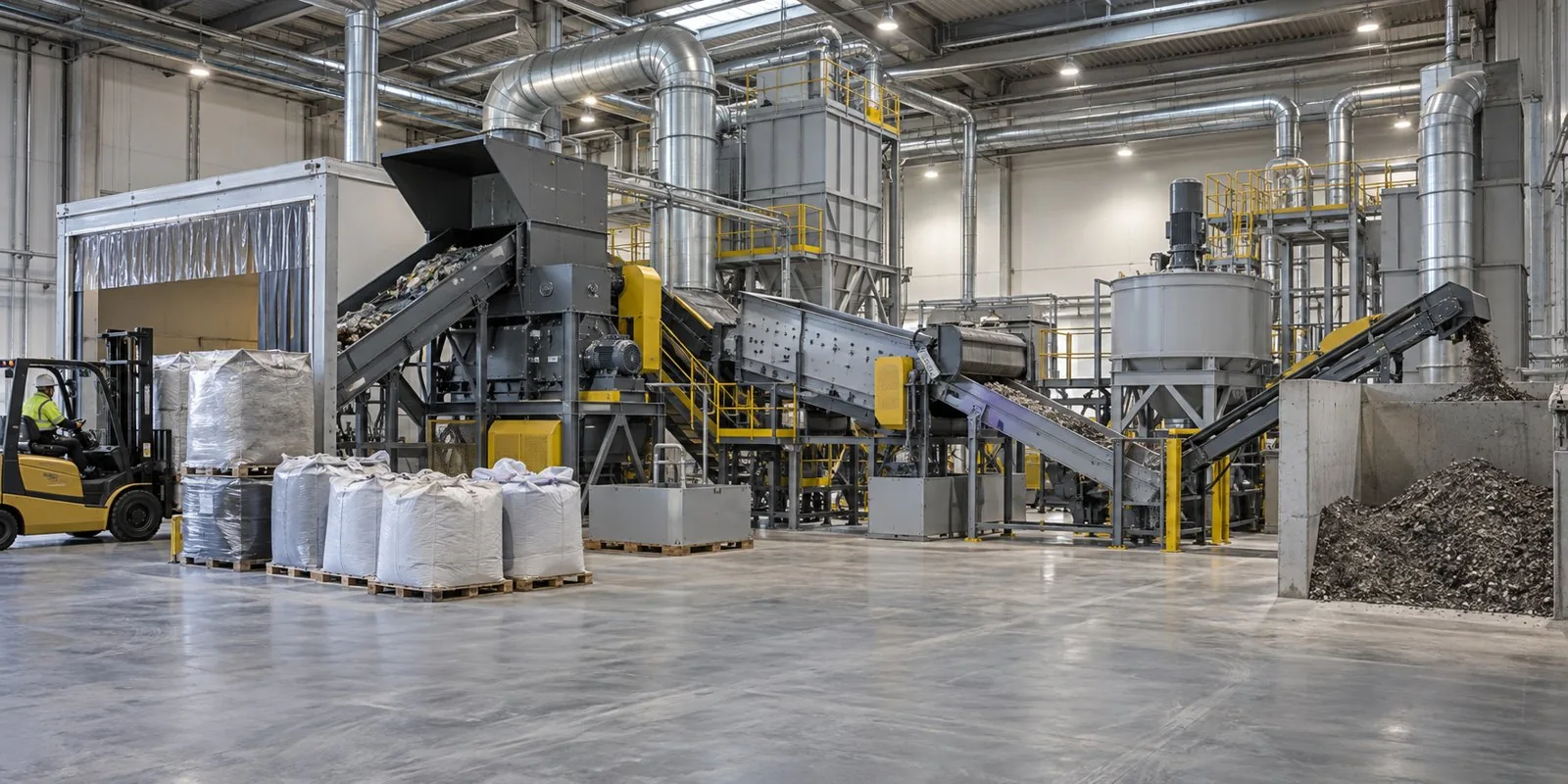
Is manual sorting enough?
Manual sorting can be enough for selected duties when the feed is variable, people can safely identify the target items and the required rate is manageable. It is useful for removing unsuitable or hazardous objects, recovering selected high-value pieces and checking product quality. It does not eliminate the need for controlled feeding, safe access, defined decisions and consistent downstream handling.
Manual work also has limits. Deep or uneven belt loading can hide items, while wet or contaminated material can make decisions slower and less consistent. The buyer should define what operators must remove or recover, the burden presented to them, the safe working arrangement and the quality standard. “Manual sorting” alone does not describe a complete process.
What do screens, magnets and eddy-current separators add?
Screens classify material by size and can protect downstream equipment or create more stable separation conditions. Magnetic separation targets responsive ferrous material when it is exposed, while eddy-current separation may recover eligible non-ferrous conductive metals after suitable size preparation. Each stage solves a different duty, so none should be selected simply because it is common on another line.
Mechanical stages depend on feed presentation. Moisture can blind screens, attached materials can shield metal and excessive burden can reduce separation quality. Buyers should ask where fines and oversize report, what remains attached after preparation and how the belt loading is controlled. Every separated stream also needs a product, recirculation or residue destination.
When is optical sorting worth the investment?
Optical sorting is worth considering when the target can be detected reliably, the pieces can be presented as a controlled and visible stream, and the separated output supports a documented product specification. It is not automatically the most advanced or most suitable choice. Sensor response, particle presentation, contamination, moisture, throughput and required purity all influence whether it has a useful duty.
The commercial question should follow the technical question. First confirm what material the sensor must identify, how the feed will be sized and spread, and what happens to accepted and rejected pieces. A short demonstration on selected clean material does not prove performance across normal, peak and seasonal feed variation.
| Option | What it means | Buyer question | What it does not prove |
|---|---|---|---|
| Manual sorting | People remove, recover or verify defined items from a controlled stream | Which items must operators identify, and at what burden? | Stable quality without safe access, training and a decision standard |
| Screening / size separation | Material is divided by size before later duties | Where do fines and oversize report? | Material identity, recovery or product purity |
| Magnetic and eddy-current separation | Ferrous and eligible non-ferrous conductive metals are separated through different physical responses | Are metals liberated, exposed and presented in a suitable size range? | Removal of every metal or separation of attached composites |
| Optical / sensor-based sorting | Detectable target pieces are identified and directed to a chosen stream | Is detection linked to a saleable product specification? | Suitability for wet, hidden, attached or poorly presented material |
| “200 t/day” throughput figure | Incoming processing scale stated on a daily basis | What operating schedule and feed envelope support the figure? | Recovered output, recovery, purity, availability or commercial return |
Does a 200 t/day line recover 200 t/day of material?
No. A 200 t/day figure describes incoming processing scale on a daily basis; it does not describe recovered-product output. The recovered quantity depends on composition, process configuration, product specifications, residue and the agreed mass-balance method. For example, China Bente’s published Venezuela record confirms a completed 200 t/day MSW sorting and material-recovery line, but it publishes no recovery or purity percentage.
Buyers should keep throughput, recovery and purity separate. Recovery asks how much target material in the feed reaches the intended product stream. Purity asks how much of that product stream is the intended material. Neither can be inferred from throughput alone, and both need defined sampling locations, test methods, moisture basis and treatment of recirculated material.
Why does feed preparation and liberation matter?
Separation works only when the relevant material property is available to the equipment. A metal part attached to plastic, wire inside insulation or a labelled container may not report cleanly to one stream. Controlled feeding, bag opening where justified, screening, cutting, shredding or other preparation may expose materials, create a suitable size range and stabilise the burden.
More preparation is not always better. Excessive size reduction can create mixed fines, dust, wear and difficult residues, while insufficient liberation can leave recoverable material in composites. The process should therefore be tested as a sequence. Buyers should ask what each preparation stage enables and how it affects every downstream product and residue stream.
What data should you prepare before choosing?
Prepare evidence that describes the feed, required outputs and site rather than asking suppliers to assume them. Representative information helps suppliers compare manual, mechanical and optical duties on the same basis. Unknown inputs should remain marked TBC with a verification action; they should not be converted into fixed composition, capacity or performance claims.
- waste source and collection method;
- representative composition and expected variation;
- moisture, item-size range and bulk-density information;
- unsuitable, hazardous, bulky or difficult items;
- incoming capacity with a clear time basis and operating schedule;
- target recovered products and required condition;
- residue classification and intended route;
- available site, building, access and storage information;
- electrical, water, drainage and compressed-air availability;
- environmental, fire, safety and responsibility boundaries.
How do you test recovery and purity at handover?
Test them with a pre-agreed sampling plan and reconciled mass balance. The plan should name the feed and product boundaries, sampling locations, increment frequency, sample preparation, test method and responsible parties. It should also define the moisture basis, operating window, representative feed condition and treatment of recirculated, retained or off-spec material.
The mass balance should compare incoming feed with recovered products, residues, retained inventory and identified losses without double counting. Commissioning records should capture feed condition, stream masses, equipment settings, downtime and test results. Mechanical availability and material performance need separate acceptance criteria because a running line can still make off-spec product.
What should you ask your supplier?
Use questions that force the proposed equipment into a documented process basis:
- Which feed composition and variation define the proposed line?
- What duty does each manual, mechanical or optical stage perform?
- How will feed preparation and belt loading support each separator?
- Where will every product, recirculation and residue stream go?
- Which utilities, site works, controls and environmental systems are included?
- How will throughput, recovery and purity be sampled and accepted at handover?
What else do buyers ask about MSW sorting?
Can manual sorting alone produce saleable recyclables?
It can produce selected saleable streams when the feed, burden, operator decisions, safety arrangements and product specification support it. Manual sorting does not by itself prove consistent purity, stable throughput or a complete route for fines, unsuitable material and residues.
Is optical sorting always better than manual sorting?
No. Optical sorting needs detectable targets and controlled feed presentation. Manual sorting may remain valuable for variable feed, exceptions and quality control. The correct combination follows the product specification and verified feed conditions.
Does a 200 t/day line recover 200 t/day of material?
No. That figure describes incoming processing scale. Recovered output depends on the target material present, the process, product specifications, residues and the agreed mass-balance method.
What samples should I send for a sorting-line proposal?
Provide representative samples or documented observations covering normal variation, moisture, item sizes, contamination, difficult objects and target materials. A selected clean sample cannot represent the full operating envelope.
How is recovery measured at handover?
Recovery is measured from target material in the incoming feed and the amount captured in the intended product stream, using an agreed sampling plan, test method, moisture basis and reconciled mass balance.
Ready to define the right sorting level?
Send us your waste composition, target products, capacity basis and site data for a scope review.