
System visuals
What It Is
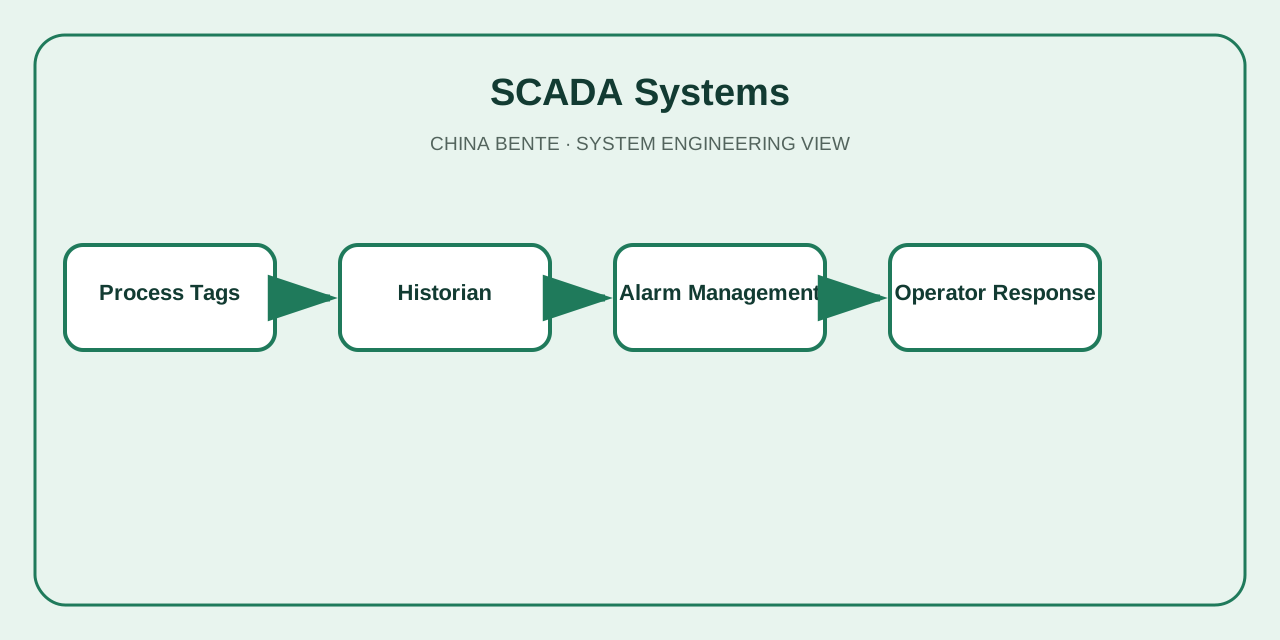
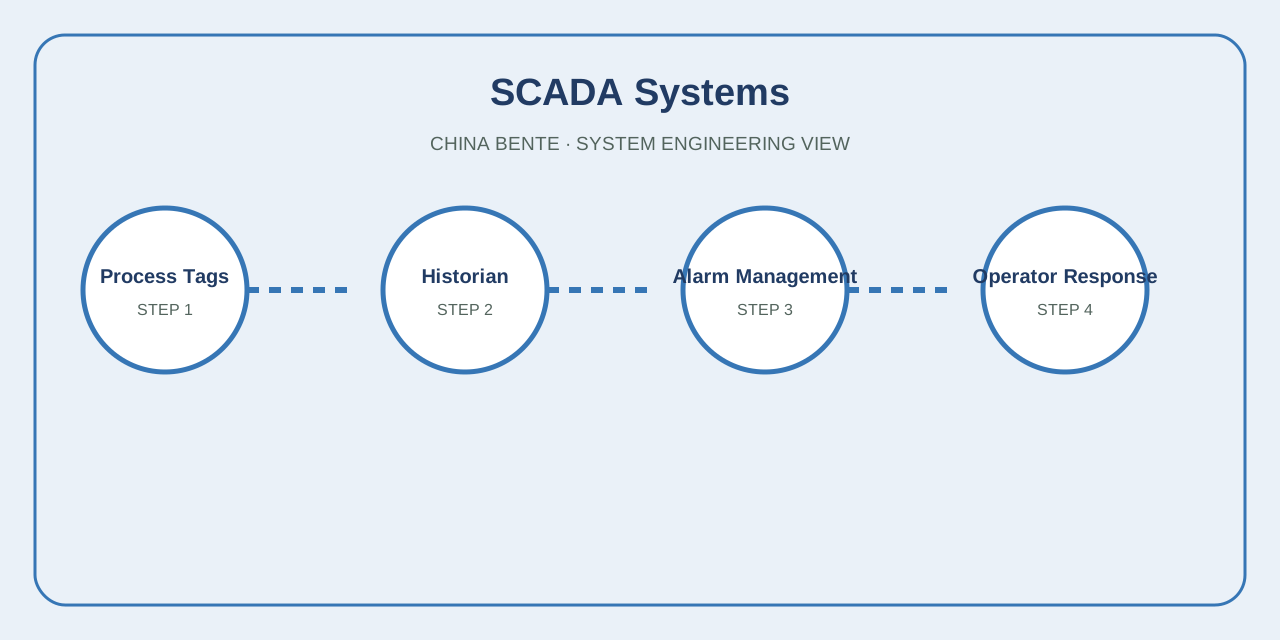
SCADA supervises distributed or plant-wide equipment by collecting trusted data, presenting status, managing alarms and trends and issuing authorized commands. It must be engineered around control ownership, communications quality, alarm philosophy, historian needs and failure operation.
Applications and Operating Objectives
Applications include utilities, water and wastewater, renewable-energy plants, pipelines, remote stations, environmental systems, factories and multi-site monitoring.
System Workflow and Architecture
Main Equipment and Software Components
Components may include SCADA servers and clients, historians, gateways, managed networks, radio/cellular/fiber links, time services, UPS, operator consoles, reporting and secure remote-access infrastructure.
Control remains in local PLC/RTU where appropriate. SCADA command authority, redundant server behavior, store-and-forward, time stamps and communication-loss indication are explicit.
Capacity and Design Basis
Design uses station and tag count, scan rates, alarm/event volume, history retention, concurrent users, screen count, communications bandwidth and availability requirements.
| Operational scale | Normal and burst data rates, remote latency, tag quality, historian growth, user sessions and expansion are calculated. |
|---|---|
| Interfaces | PLC/RTU protocols, reporting databases, GIS, CMMS, laboratory, identity and notification interfaces define data ownership and failure handling. |
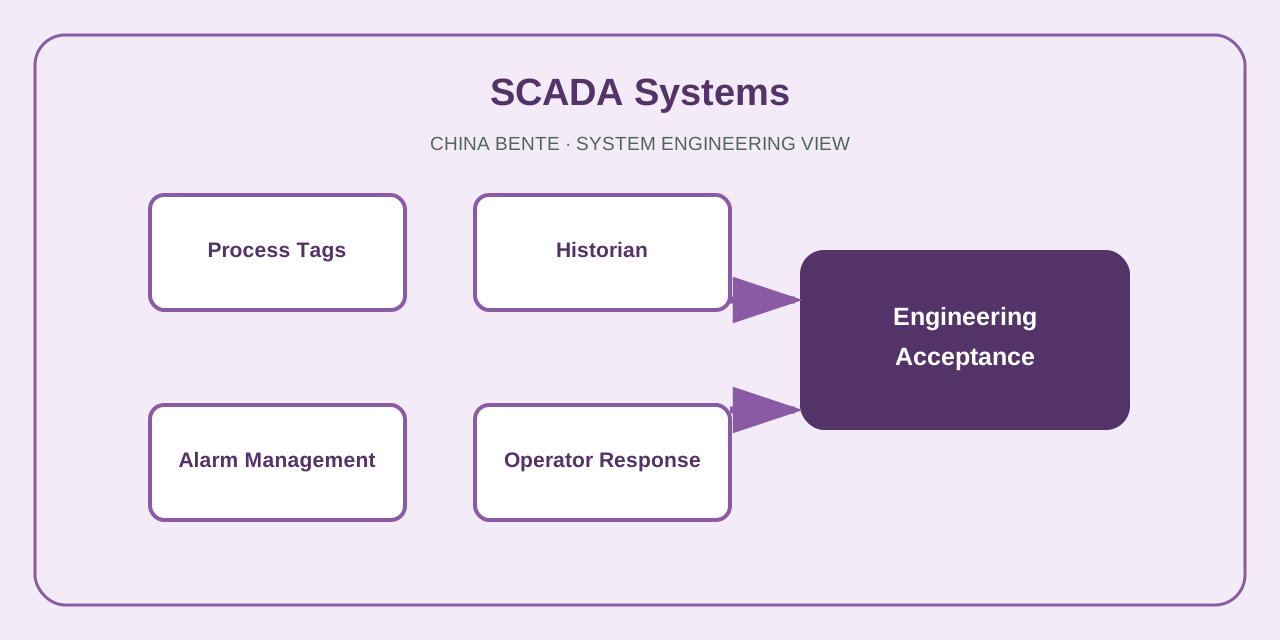
| Performance basis | Acceptance covers tag accuracy, command handshake, alarm priority/deadband, event order, trend/history, failover, communication loss, backup/restore and role permissions. |
| Unknown/TBC | Unverified tag counts, cycle times, accuracy, latency, availability, savings and integration scope remain TBC until discovery and testing. |
Utilities and Infrastructure
Server or virtual environment, storage, backup, network/security zones, communications links, time synchronization, UPS, console ergonomics and cooling are assessed.
Required Customer Engineering Inputs
Customers provide site and station inventory, tag lists, PLC maps, network and radio details, alarm philosophy, reports, history needs, user roles, cybersecurity and recovery targets.
Data, Automation and Control
Commands use confirmation, status feedback and authorization. Alarm rationalization prevents nuisance flooding, and historian quality flags distinguish bad or stale data.
Cybersecurity and Access Control
SCADA zones, identity, remote access, logging, backups, allow-listing and patch process are coordinated without exposing control endpoints to the public internet.
CAPEX and OPEX Drivers
CAPEX depends on tag/station scale, communications, redundancy, migration, historian and reporting. OPEX includes licenses, telecoms, backups, patching, cybersecurity monitoring and content changes.
Safety, Compliance and Lifecycle
Loss of SCADA must not remove necessary local protection. Remote commands, alarm suppression and maintenance overrides are governed and auditable.
Outputs and Acceptance Basis
Deliverables include architecture, tag database, graphics, alarms, reports, historian, tested redundancy, communications records, source/configuration backups, manuals and training.
Implementation and Commissioning
Implementation proceeds through standards and pilot, offline configuration, simulated FAT, staged station migration, parallel observation where practical, SAT and formal operational handover.
Project Evidence
No production gain, accuracy, uptime or savings figure is claimed without approved evidence. Any reference used during evaluation will identify its scope and verification status. This page uses a system architecture diagram and does not present a concept image as a completed client project.
Frequently Asked Questions
Can SCADA directly replace a PLC?
Normally no. SCADA is supervisory, while deterministic interlocks and local control remain in PLC/RTU or DCS.
What happens when a remote link fails?
Local control continues as designed, SCADA shows bad/stale quality, and buffered data may forward after restoration.
How many tags can the system handle?
Capacity is selected from verified tag count, scan rate, users, history and expansion rather than a generic maximum.
How are nuisance alarms reduced?
By rationalization, priorities, deadbands, delays, state-based suppression and ownership of corrective actions.
Can operators control sites remotely?
Only approved commands with role, confirmation, feedback, communication quality and local safety conditions.
Where is history stored?
In an agreed historian or database with retention, backup, quality flags and access rules.
Is cellular communication acceptable?
It can be where coverage, latency, security, data volume and resilience meet project needs.
How is an old SCADA migrated?
By inventorying tags/screens/alarms, preserving required behavior, testing offline and cutting over in controlled stages.
Related Engineering Links
Smart & Intelligent Solutions overview · AI Vision Inspection · Digital Twin & Data Platform · Projects & Cases · Request a Project Evaluation
Request a Project Evaluation
Provide process narratives, I/O or tag lists, network and system inventory, production objectives, existing backups, data interfaces, cybersecurity rules and acceptance priorities. Unknown information may remain TBC.