
System visuals
What It Is
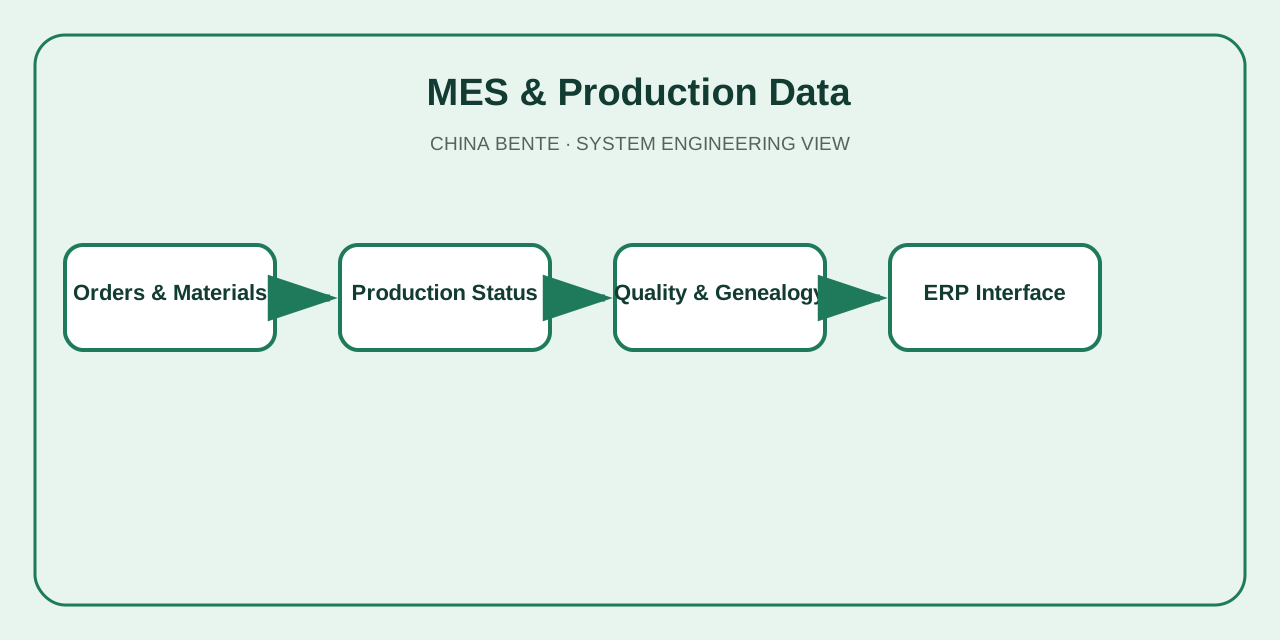
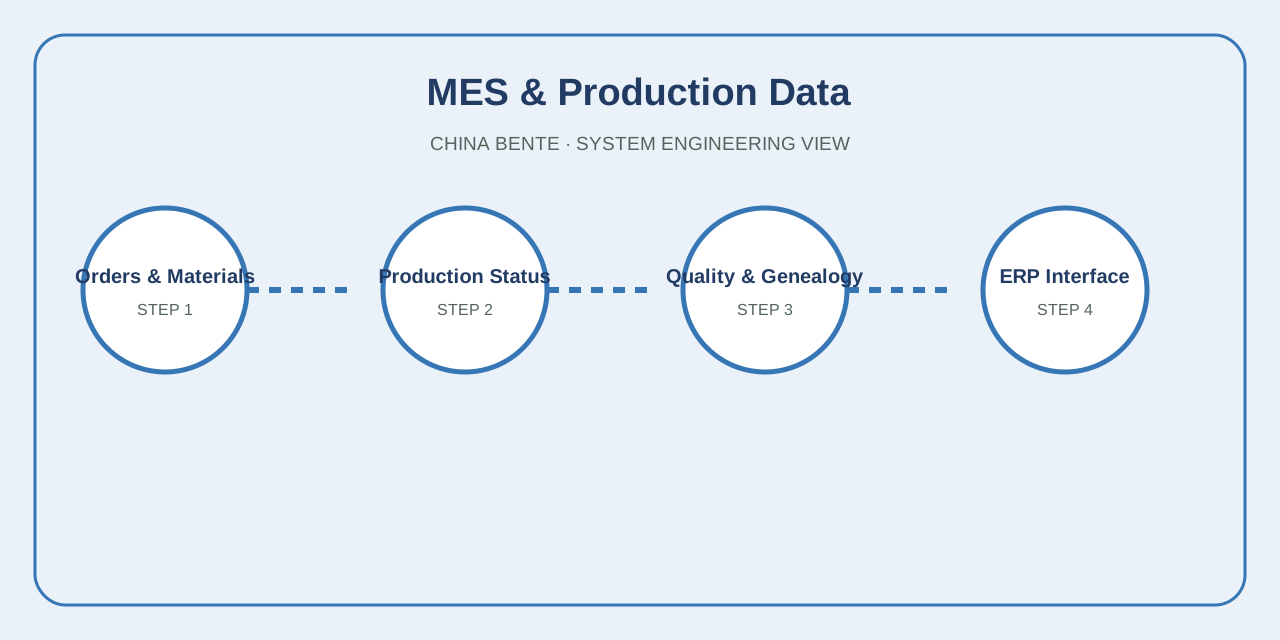
A Manufacturing Execution System coordinates production orders, material, equipment, recipes, quality and status between real-time plant controls and enterprise planning. Production-data management supplies the governed asset, event and genealogy context needed for trustworthy reports and decisions.
Applications and Operating Objectives
Applications include order dispatch, WIP tracking, batch and lot genealogy, electronic work instructions, quality checks, downtime/OEE, material consumption, production reporting and ERP integration.
System Workflow and Architecture
Main Equipment and Software Components
Components can include MES application and database, integration middleware/API, edge or historian connectors, user terminals, barcode/RFID devices, label printers, reporting, identity and backup services.
The system of record for each data object is agreed. MES does not send uncontrolled commands to equipment; dispatch and recipe paths use authorization, validation and acknowledgment.
Capacity and Design Basis
Sizing uses lines, products, routes, orders, transactions, users, devices, data retention, integration frequency, recipe/version complexity and required availability.
| Operational scale | Peak transactions, genealogy depth, label volume, concurrent users, history, reports and site expansion are measured. |
|---|---|
| Interfaces | ERP orders/materials, PLC/SCADA events, laboratory results, quality holds, CMMS status, warehouse movements and identity roles require governed contracts. |
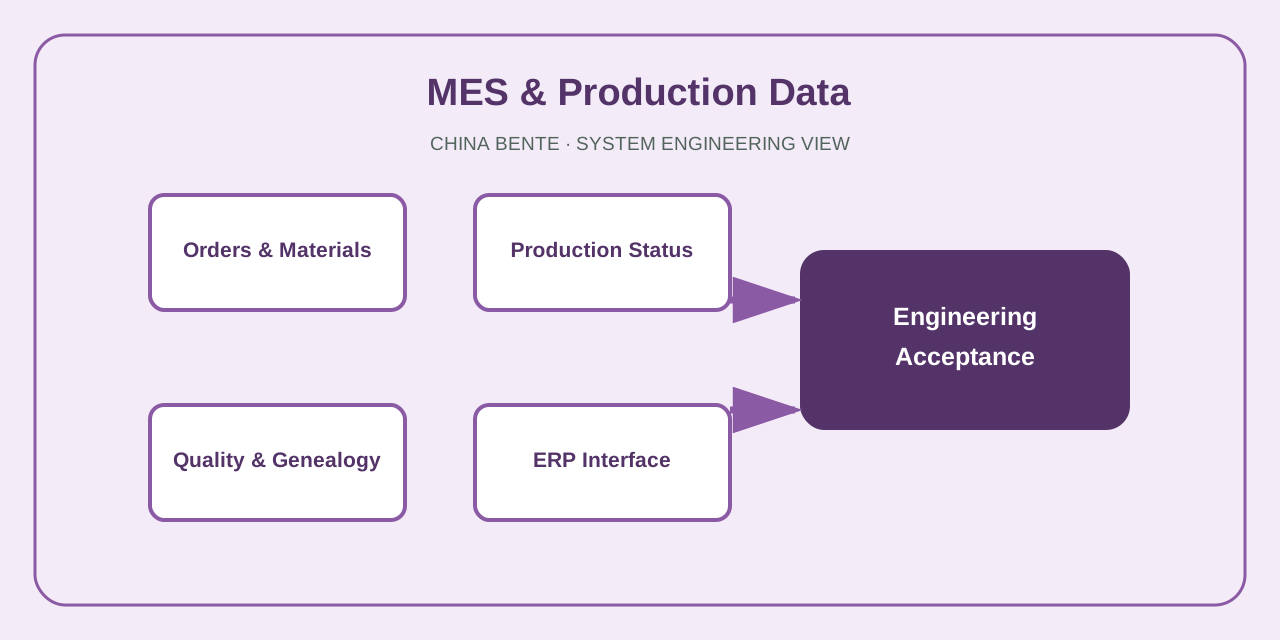
| Performance basis | Acceptance covers approved workflows, traceability, data reconciliation, exception handling, roles, audit trail, interface recovery, reports and backup/restore. |
| Unknown/TBC | Unverified tag counts, cycle times, accuracy, latency, availability, savings and integration scope remain TBC until discovery and testing. |
Utilities and Infrastructure
Application/database servers or cloud, network and edge connectivity, terminals, scanners, printers, time synchronization, backup, test environment and support tools are assessed.
Required Customer Engineering Inputs
Customers provide product and routing master data, current forms and workflows, ERP/interface details, equipment hierarchy, tag/events, quality and genealogy rules, user roles, reporting and validation needs.
Data, Automation and Control
MES validates orders, materials and workflow states, while PLC/SCADA remains responsible for safe real-time control. Data quality and reconciliation rules handle missing, late or corrected events.
Cybersecurity and Access Control
Identity, least privilege, audit logs, segregation of test and production, API security, backup, patch and vendor support access are defined with owner governance.
CAPEX and OPEX Drivers
CAPEX depends on workflows, interfaces, devices, data migration, validation and multi-site scope. OPEX includes licensing, master-data governance, support, changes, backups and cybersecurity.
Safety, Compliance and Lifecycle
Electronic instructions and recipes require approval and revision control. System unavailability must have an agreed manual or degraded operating procedure.
Outputs and Acceptance Basis
Outputs include configured workflows, master-data model, interfaces, validated traceability and reports, reconciliation tests, source/configurations, admin and user training, recovery and support procedures.
Implementation and Commissioning
Delivery uses blueprint, prototype, interface and data build, pilot with representative products, user acceptance, controlled migration, hypercare and governed rollout.
Project Evidence
No production gain, accuracy, uptime or savings figure is claimed without approved evidence. Any reference used during evaluation will identify its scope and verification status. This page uses a system architecture diagram and does not present a concept image as a completed client project.
Frequently Asked Questions
Is MES the same as ERP?
No. ERP plans and manages business resources, while MES coordinates shop-floor execution and detailed production records.
Does MES replace SCADA?
No. SCADA supervises equipment; MES manages orders, materials, workflows, quality and genealogy above real-time control.
Can MES improve OEE automatically?
It can provide reliable loss data and workflows, but improvement depends on verified causes and operational action.
How is genealogy built?
Material, lot, equipment, order and process events are linked through approved identifiers and transactions.
What if an interface is unavailable?
Queueing, retry, reconciliation and controlled manual procedures are defined for each critical exchange.
How are recipe changes controlled?
With roles, version approval, effective date, audit trail and verified download/acknowledgment where applicable.
Is data migration required?
Only data needed for operations, compliance or continuity should be cleansed, mapped and validated.
What makes a pilot successful?
Representative products and exceptions, committed users, stable source data and measurable acceptance criteria.
Related Engineering Links
Smart & Intelligent Solutions overview · AI Vision Inspection · Digital Twin & Data Platform · Projects & Cases · Request a Project Evaluation
Request a Project Evaluation
Provide process narratives, I/O or tag lists, network and system inventory, production objectives, existing backups, data interfaces, cybersecurity rules and acceptance priorities. Unknown information may remain TBC.