
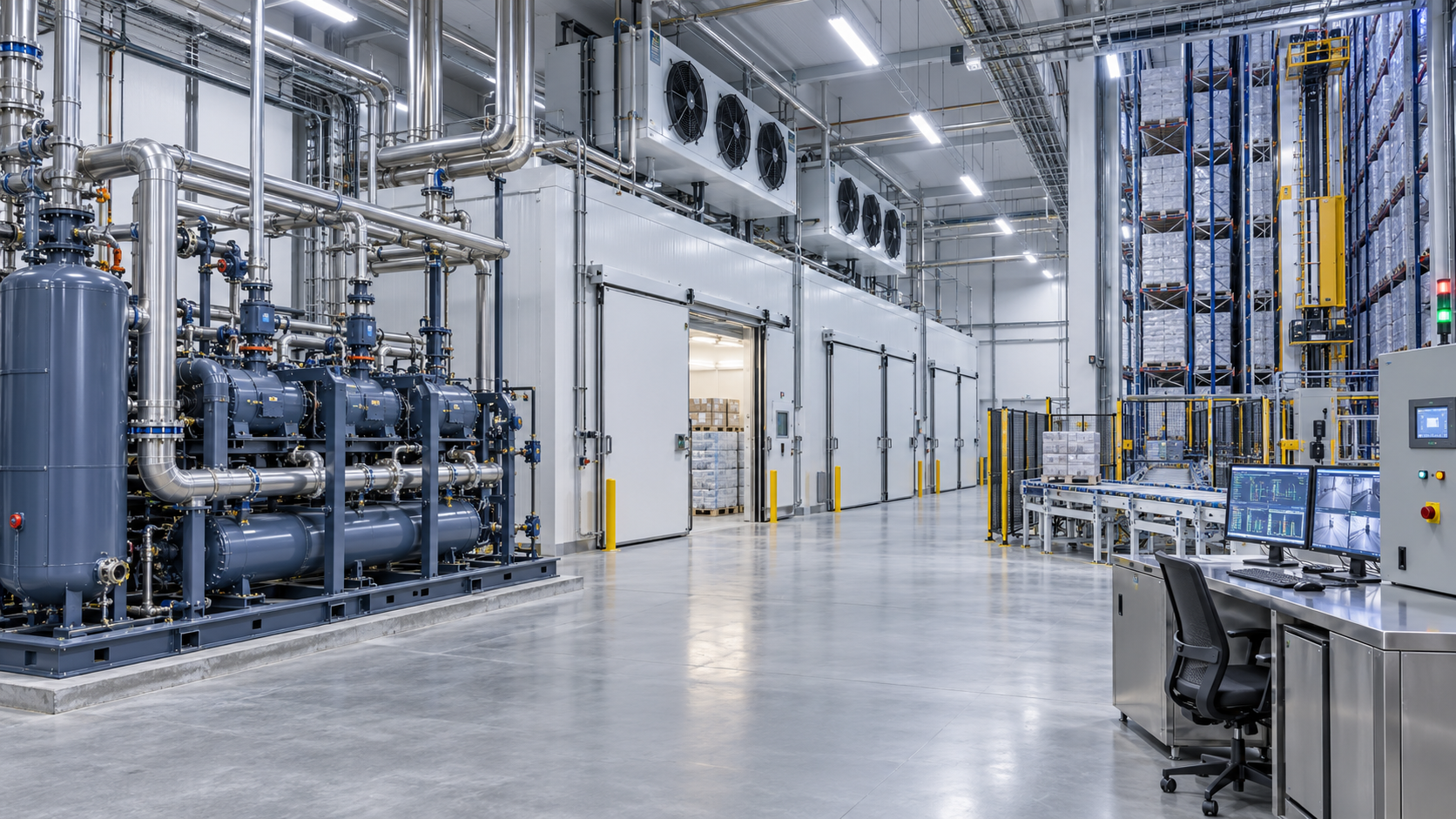
Cold stores and industrial refrigeration packages for food, logistics, pharmaceutical and process applications.
Technical Parameter & Capacity Range
Preliminary engineering selection range: Installed refrigeration duty; temperatures and redundancy are selected from product load, pull-down time, climate and operating profile. Final guaranteed values are issued only after feed/product data, utilities, site conditions and performance-test criteria are confirmed.
| Plant scale | Typical capacity range | Key technical envelope | Typical configuration |
|---|---|---|---|
| Compact | 50–500 kW | +15 to −25 °C typical zones | Single or duty/standby compressor package |
| Standard | 0.5–5 MW | +10 to −35 °C multi-zone operation | Central rack, heat recovery and PLC/SCADA controls |
| Large | 5–20+ MW | Blast freezing / automated cold store as required | Multiple compressor circuits with N+1 philosophy where specified |
Process Configuration Flow
Process Flow
- 1. Thermal load and temperature zoning
- 2. Refrigerant and system architecture selection
- 3. Panel and equipment package engineering
- 4. Piping, controls and safety integration
- 5. Installation, pressure testing and evacuation
- 6. Pull-down testing, commissioning and training
Main Equipment
- Compressors and packaged racks
- Condensers, evaporators and air coolers
- Insulated panels, doors and dock interfaces
- PLC, sensors, alarms and energy monitoring
Utilities and Environmental Interfaces
Electrical supply, backup strategy, water where applicable, drainage, defrost energy and communications are coordinated with the building.
Refrigerant containment, leak detection, machinery-room ventilation, condensate drainage and emergency response are addressed by system type.
Customer Inputs Required
Room sizes, products, throughput, entry temperature, target temperatures, ambient design conditions, operating profile and local refrigerant rules.
EPC Delivery Scope
Concept and feasibility alignment, process and layout engineering, equipment integration, procurement coordination, installation supervision, commissioning support, operator training and handover documentation. Final battery limits are confirmed in the project proposal.
Frequently Asked Questions
What information is required to define a Industrial Refrigeration & Cold Chain Systems project?
Target products, capacity, raw-material specification, site conditions, utilities, local codes and desired automation level are required before concept engineering.
Can the Industrial Refrigeration & Cold Chain Systems plant be configured in phases?
Yes. The layout and utility backbone can be planned for staged capacity, subject to site and process constraints.
How is the industrial refrigeration & cold chain systems process selected?
Selection is based on feed and product specifications, capacity, energy balance, environmental requirements and lifecycle cost.
Which utilities must the customer confirm for Industrial Refrigeration & Cold Chain Systems?
Available electricity, water, fuel, steam or thermal oil, compressed air, drainage and communications should be confirmed for the selected process.
Which environmental controls apply to Industrial Refrigeration & Cold Chain Systems?
Collection and treatment interfaces for dust, fumes, wastewater, noise and solid residues are defined according to the process and applicable local standards.
What is included in Industrial Refrigeration & Cold Chain Systems commissioning?
Commissioning scope can include dry tests, utility checks, interlock tests, trial production, performance verification and operator training.
Can local equipment and civil contractors be integrated into Industrial Refrigeration & Cold Chain Systems?
Yes. A responsibility matrix can divide imported packages, locally sourced equipment, civil works and installation while preserving interface control.
How are Industrial Refrigeration & Cold Chain Systems schedule and performance guarantees finalized?
They are set only after feed data, product specification, battery limits, site inputs and acceptance criteria are jointly confirmed.