
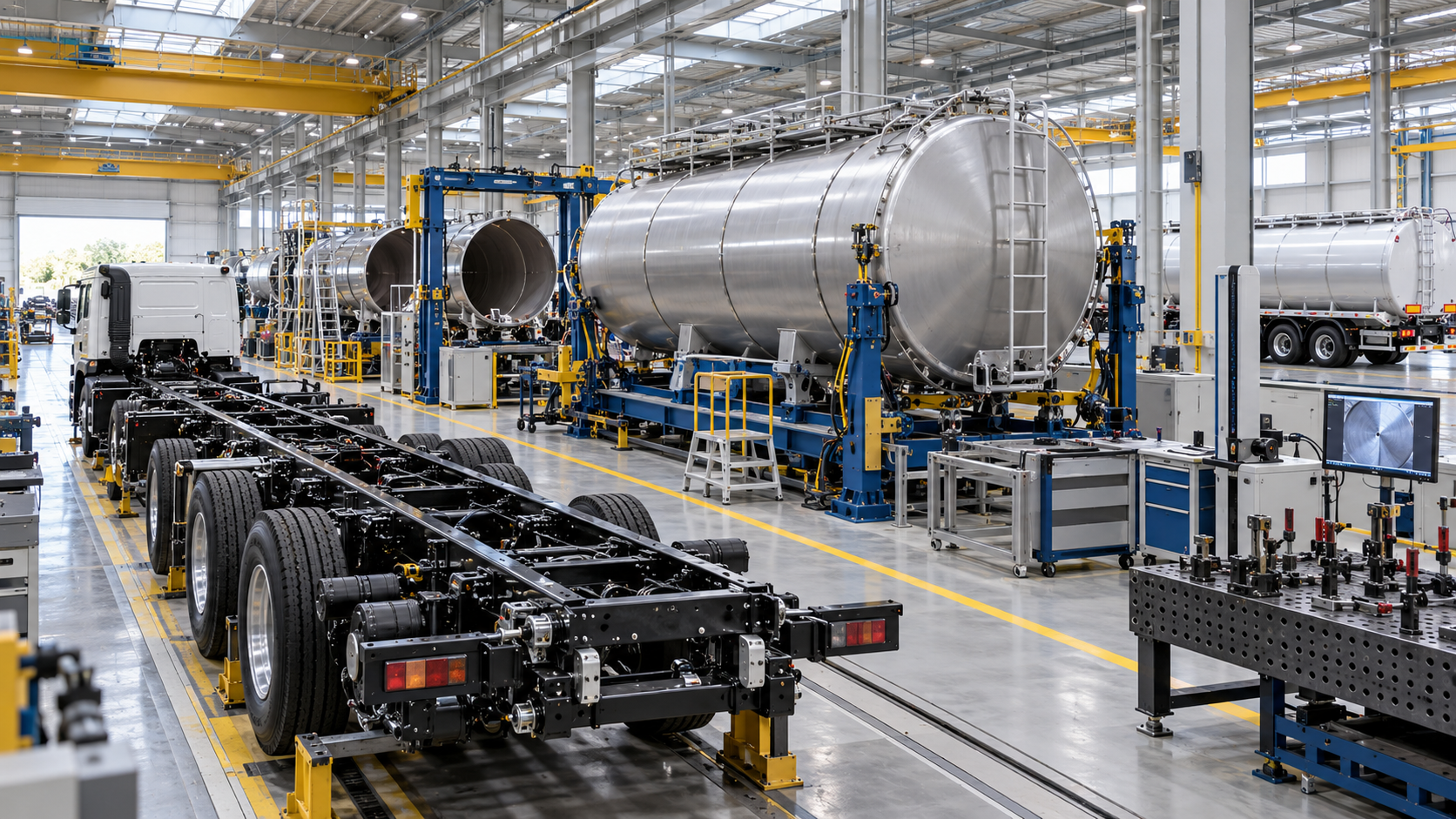
Flexible manufacturing for road tankers, trailers, transport bodies and application-specific special vehicles.
Technical Parameter & Capacity Range
Preliminary engineering selection range: Finished units per 8-hour shift; vessel volume, axle load, material grade and statutory inspection define the final line balance. Final guaranteed values are issued only after feed/product data, utilities, site conditions and performance-test criteria are confirmed.
| Plant scale | Typical capacity range | Key technical envelope | Typical configuration |
|---|---|---|---|
| Compact | 2–10 units/shift | Tank volume typically 1–20 m³ | Cutting/forming bays with manual fit-up and test station |
| Standard | 10–30 units/shift | Tank volume typically 5–45 m³ | Dedicated welding cells, blasting/painting and assembly line |
| High-output | 30–60+ units/shift | Multiple product families or chassis types | Parallel fabrication bays with automated tracking and final test |
Process Configuration Flow
Process Flow
- 1. Product engineering and material nesting
- 2. Plate cutting, rolling and forming
- 3. Robotic/manual welding and NDT
- 4. Surface preparation and coating
- 5. Chassis, piping and accessory assembly
- 6. Leak, brake, road and final inspection
Main Equipment
- CNC cutting and bending systems
- Plate rolls, welding stations and manipulators
- Blast/paint booths and curing equipment
- Assembly bays, test rigs and material handling
Utilities and Environmental Interfaces
Power, compressed air, shielding gas, ventilation, paint-booth utilities and safe lifting systems are defined by product mix.
Welding fume capture, blasting dust recovery, coating VOC control and wash-water management are included as required.
Customer Inputs Required
Vehicle types, tank materials, applicable transport codes, annual mix, axle/chassis source, coating system and inspection regime.
EPC Delivery Scope
Concept and feasibility alignment, process and layout engineering, equipment integration, procurement coordination, installation supervision, commissioning support, operator training and handover documentation. Final battery limits are confirmed in the project proposal.
Frequently Asked Questions
What information is required to define a Transport Equipment, Tanks & Special Vehicles project?
Target products, capacity, raw-material specification, site conditions, utilities, local codes and desired automation level are required before concept engineering.
Can the Transport Equipment, Tanks & Special Vehicles plant be configured in phases?
Yes. The layout and utility backbone can be planned for staged capacity, subject to site and process constraints.
How is the transport equipment, tanks & special vehicles process selected?
Selection is based on feed and product specifications, capacity, energy balance, environmental requirements and lifecycle cost.
Which utilities must the customer confirm for Transport Equipment, Tanks & Special Vehicles?
Available electricity, water, fuel, steam or thermal oil, compressed air, drainage and communications should be confirmed for the selected process.
Which environmental controls apply to Transport Equipment, Tanks & Special Vehicles?
Collection and treatment interfaces for dust, fumes, wastewater, noise and solid residues are defined according to the process and applicable local standards.
What is included in Transport Equipment, Tanks & Special Vehicles commissioning?
Commissioning scope can include dry tests, utility checks, interlock tests, trial production, performance verification and operator training.
Can local equipment and civil contractors be integrated into Transport Equipment, Tanks & Special Vehicles?
Yes. A responsibility matrix can divide imported packages, locally sourced equipment, civil works and installation while preserving interface control.
How are Transport Equipment, Tanks & Special Vehicles schedule and performance guarantees finalized?
They are set only after feed data, product specification, battery limits, site inputs and acceptance criteria are jointly confirmed.