
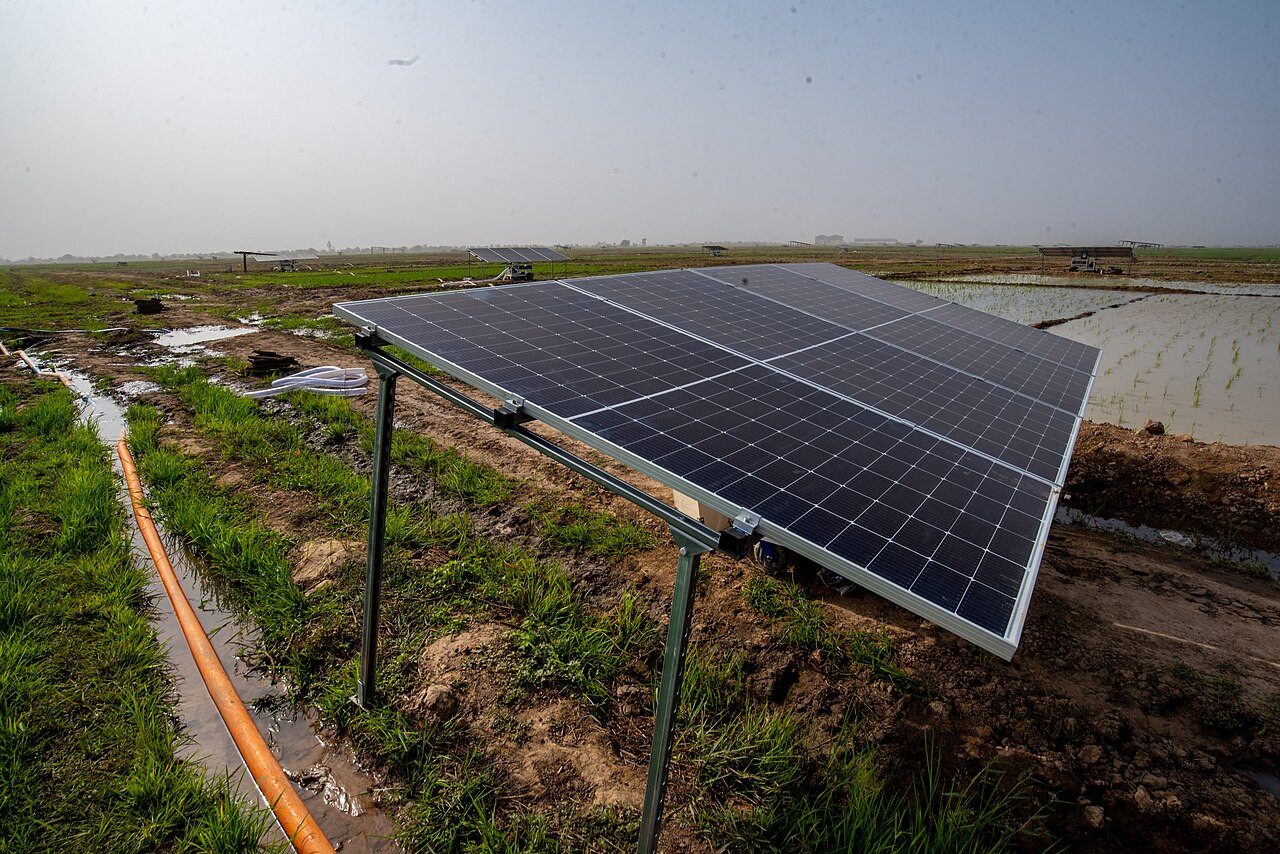
Match photovoltaic generation to the water source, total dynamic head and daily irrigation requirement. Water storage can sometimes provide the operating buffer more simply than electrical batteries.
Process and equipment architecture
- Assess water source and demand
- Measure head and pipe losses
- Select pump duty and controller
- Size PV and storage
- Install protection and distribution
- Test flow, controls and daily delivery
Main equipment and supply boundary
PV modules and structure, pump-compatible controller or variable-frequency drive, submersible or surface pump, intake protection, pipes and valves, flow/pressure/level instruments, water storage, irrigation interfaces and remote monitoring where required.
Technical parameters and capacity basis
| Parameter | Unit / basis | Design requirement |
|---|---|---|
| Daily water requirement | m³/day | Derive from crop area, season, irrigation method and allowable schedule. |
| Pump duty | m³/h at m head | Include static lift, drawdown, discharge pressure and friction losses. |
| Pump motor | kW; V | Select duty point and compatible controller; verify efficiency and starting behavior. |
| PV supply | kWp | Model local irradiance, losses and usable pumping hours. |
| Water storage | m³ | Account for peak demand, autonomy and evaporation where applicable. |
| Water quality | Solids; salinity; corrosion | Check pump materials, filtration and emitter requirements. |
| Protection and controls | Levels; pressure; flow | Include dry-run, overflow, electrical protection and safe fallback. |
Numerical equipment ratings and guaranteed values are established in the project datasheet after the operating inputs are verified; units shown here are not fixed product ratings.
Engineering inputs
Location; water-source tests and seasonal levels; crop area and water schedule; elevation survey; pipe lengths and diameters; water analysis; storage options and existing pump details.
Frequently asked questions
Should a solar pump use batteries?
Not necessarily. Compare water storage and daytime pumping with the irrigation schedule before adding electrical storage.
How do you calculate total head?
Combine static lift, source drawdown, required delivery pressure and pipe/fitting losses at the design flow.
Will the pump deliver constant flow all day?
PV power varies with weather and time. The controller, pump curve and storage strategy determine achievable flow and daily volume.
Can the system use an existing pump?
Check motor/controller compatibility, pump condition, duty point, cabling and protection before reuse.
How is dry running prevented?
Use appropriate source-level or dry-run protection, with defined stop, alarm and restart logic.
Can it connect to drip irrigation?
Yes, with the required filtration, pressure control, zoning and water quality. Coordinate delivery with the irrigation designer.
What if the water source falls seasonally?
Use seasonal pumping tests and drawdown data. Set abstraction limits and protection to avoid overpumping.
What is verified at commissioning?
Measure flow and pressure, check power/control behavior, source and tank levels, protection, leakage and the agreed daily-delivery test conditions.