
System visuals
What It Is
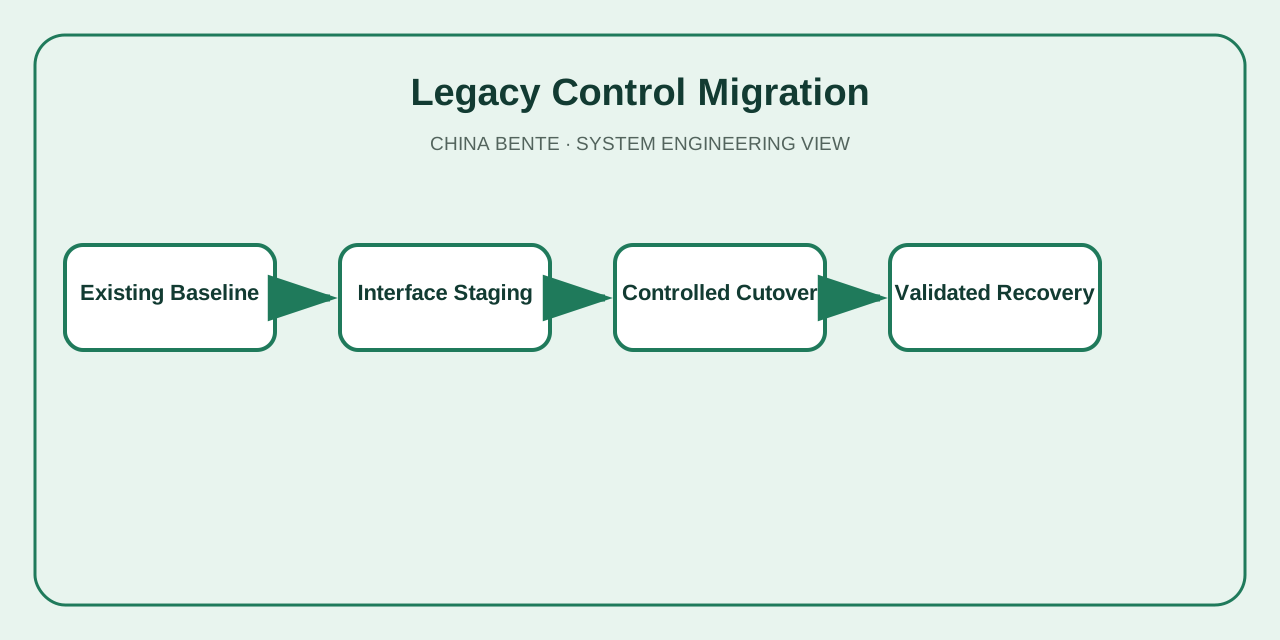
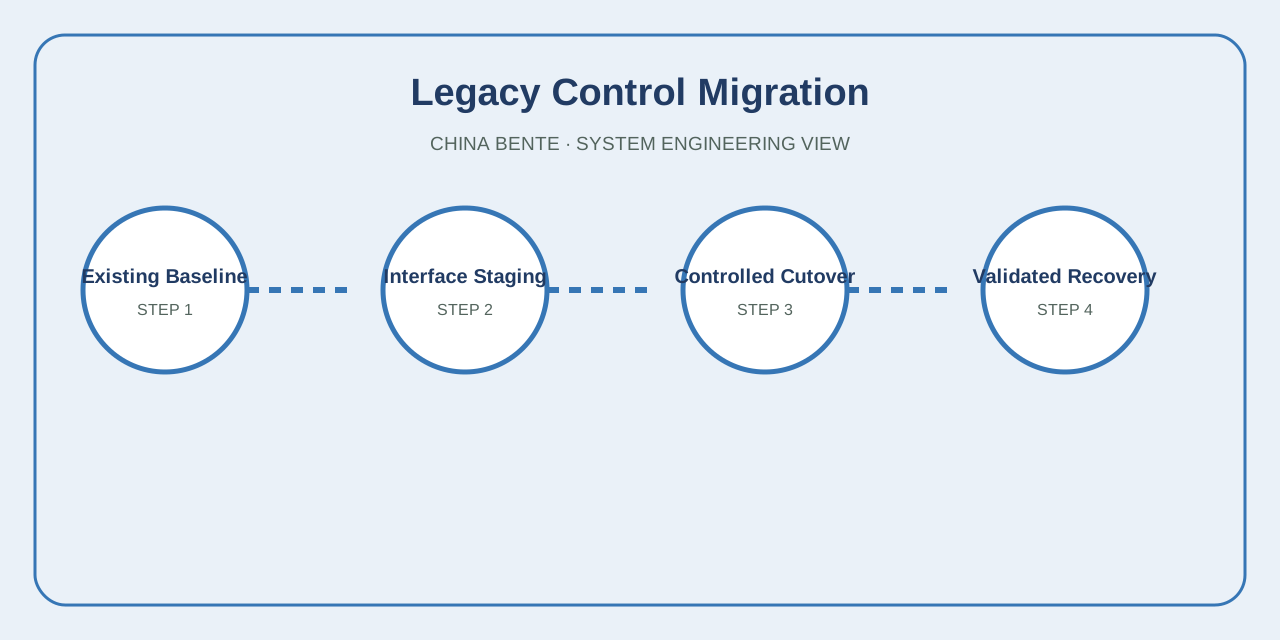
Legacy control-system migration replaces obsolete or unsupported controllers, I/O, operator stations, networks or software while preserving approved process and safety behavior. The work must recover actual field conditions, distinguish required logic from historical defects and create a tested rollback/cutover plan.
Applications and Operating Objectives
Applications include obsolete PLC/HMI, unsupported DCS/SCADA, unavailable spares, undocumented modifications, proprietary networks, server operating-system replacement and phased plant modernization.
System Workflow and Architecture
Migration can be controller-by-controller, line-by-line or system-wide. Temporary gateways and parallel operation are controlled and removed or documented after cutover.
Main Equipment and Software Components
Scope may include new controllers and I/O, adapters, panels, HMI/SCADA servers, networks, gateways, engineering workstation, simulation/test environment, configuration tools and spare strategy.
Capacity and Design Basis
Design uses recovered I/O and logic, process narratives, cause-and-effect, scan/timing, availability, spare and lifecycle requirements, shutdown windows and owner standards.
| Operational scale | I/O, programs, screens, alarms, recipes, interfaces, panels, cutover points, test cases and critical spares are counted. |
|---|---|
| Interfaces | Field instruments, drives, packages, safety systems, historian, MES/ERP and network services have mapped old/new commands, states, timing and failure behavior. |
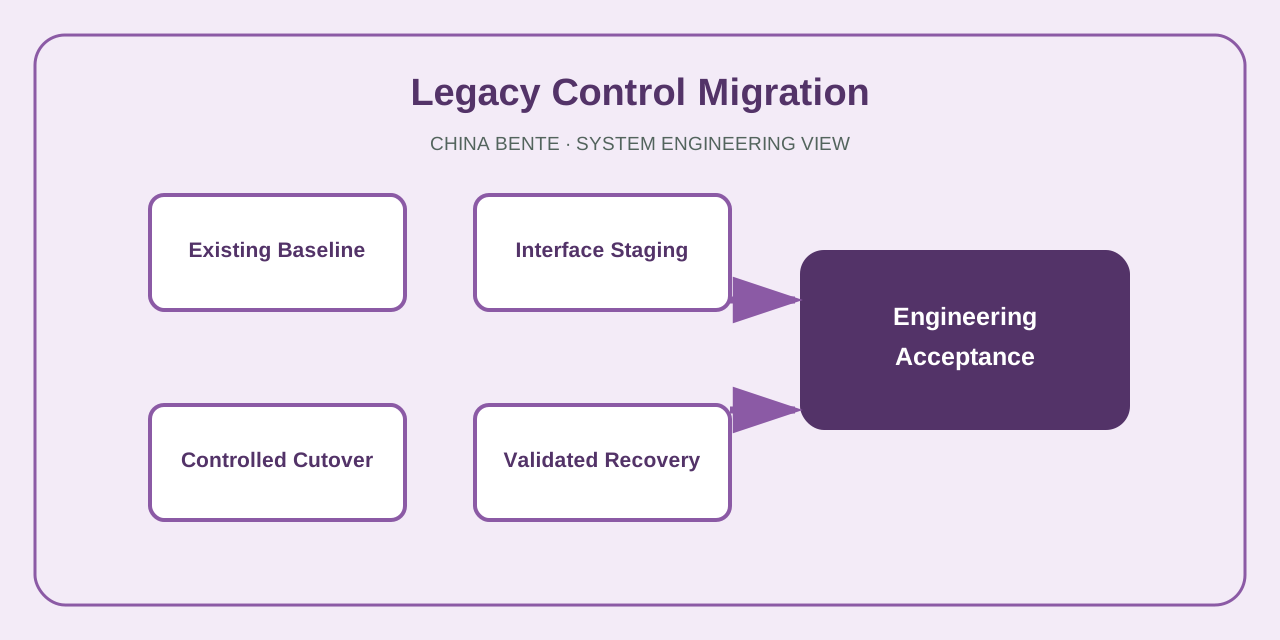
| Acceptance performance | Acceptance verifies I/O and loops, sequences, interlocks, alarms, modes, interfaces, restart, performance-sensitive timing, backups and rollback conditions. |
| Unknown/TBC | Unverified counts, latency, accuracy, availability, savings and integration assumptions remain TBC until survey and testing. |
Utilities and Infrastructure
Panel space and power, wiring condition, marshalling, network/fiber, server/virtual environment, UPS, cooling, test bench, spares and shutdown access are assessed.
Required Customer Engineering Inputs
Customers provide source and backups if available, drawings, I/O and alarm lists, process narratives, incident history, bypasses, vendor interfaces, shutdown limits, spares and site standards.
Data, Automation and Control
Original behavior is documented before conversion. Unsafe or defective behavior is not silently copied; deviations require owner review, design basis and test evidence.
Cybersecurity and Access Control
The target adds supported access, account and backup controls without exposing the system. Temporary migration connections are authorized, monitored and removed.
CAPEX and OPEX Drivers
CAPEX depends on missing source, panel rewiring, I/O adapters, software conversion, interfaces, simulation and outage. OPEX reflects spares, licenses, support, backups and lifecycle refresh.
Safety, Compliance and Lifecycle
Migration hazard review covers loss of control, wrong wiring/scaling, bypasses, stale drawings, partial cutover and rollback. Safety functions receive appropriate independent validation.
Outputs and Acceptance Basis
Deliverables include inventory and recovered baseline, approved target, converted source/HMI, I/O and test records, interface and network as-builts, backups/licenses, rollback evidence, manuals and training.
Implementation and Commissioning
Execution uses backup and survey, functional recovery, design and simulation, FAT, pre-outage preparation, controlled cutover with hold points, SAT, monitored production and formal closeout.
Project Evidence
Frequently Asked Questions
Can software be automatically converted?
Tools may assist, but logic, timing, alarms, interfaces and operator behavior require engineering review and testing.
What if source code is unavailable?
Uploads, online observation, drawings and tests may recover behavior, but comments and intent may remain TBC and increase risk.
Can migration occur with no shutdown?
Some preparation can, but physical I/O and final control transfer usually require a safe approved cutover window.
Should every old behavior be copied?
No. Required behavior is preserved; defects or unsafe practices need approved correction rather than silent replication.
How is rollback handled?
Trigger points, backups, physical reconnection and decision authority are defined and rehearsed where practical.
Can old I/O remain temporarily?
Adapters or phased migration may be feasible after compatibility, lifecycle and failure-risk review.
How are hidden field changes found?
By comparing drawings, cabinets, online configuration, loop checks and operator/maintenance knowledge.
What confirms completion?
Signed FAT/SAT, stable monitored operation and delivered source, backups, licenses, as-builts, spares and training.
Related Engineering Links
Smart & Intelligent Solutions overview · AI Vision Inspection · Digital Twin & Data Platform · Projects & Cases · Request a Project Evaluation
Request a Project Evaluation
Provide system inventory, network and control drawings, data samples, user and security requirements, existing backups, operational constraints and acceptance priorities. Unknown information may remain TBC.