
System visuals
What It Is
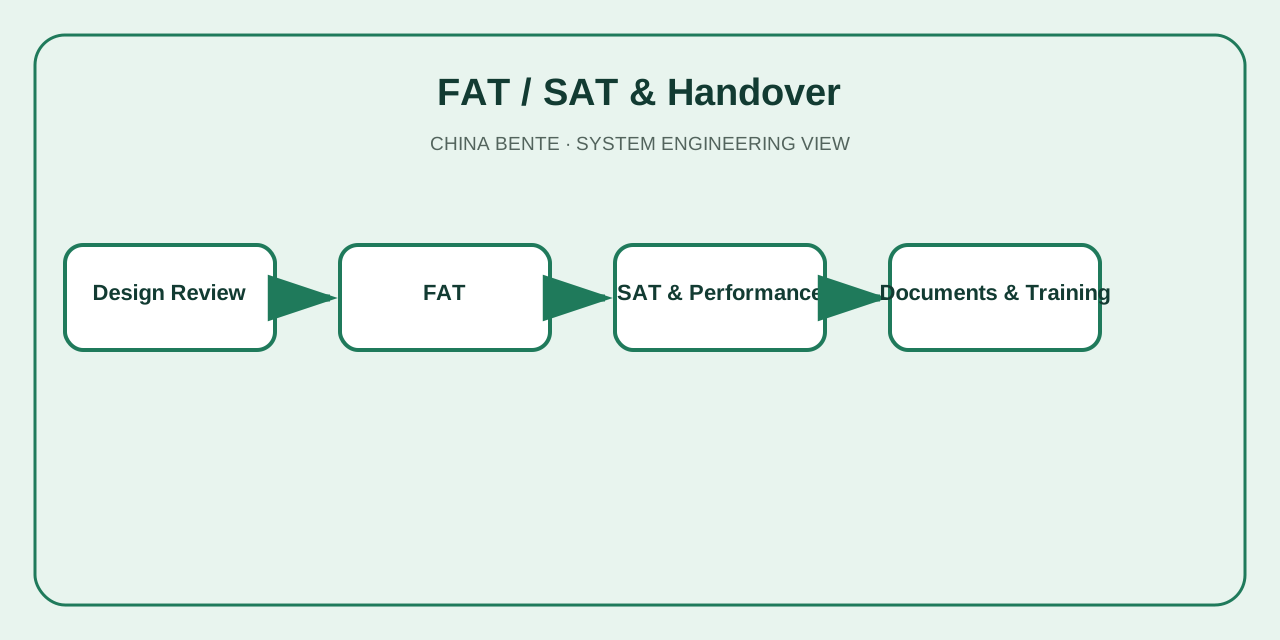
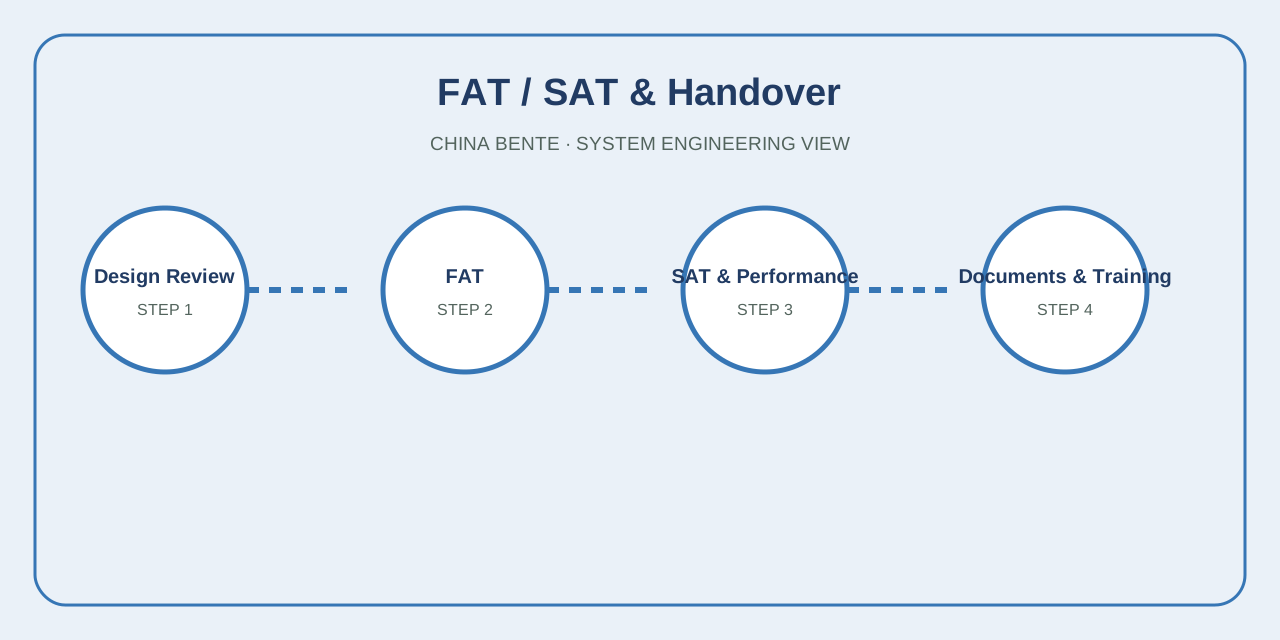
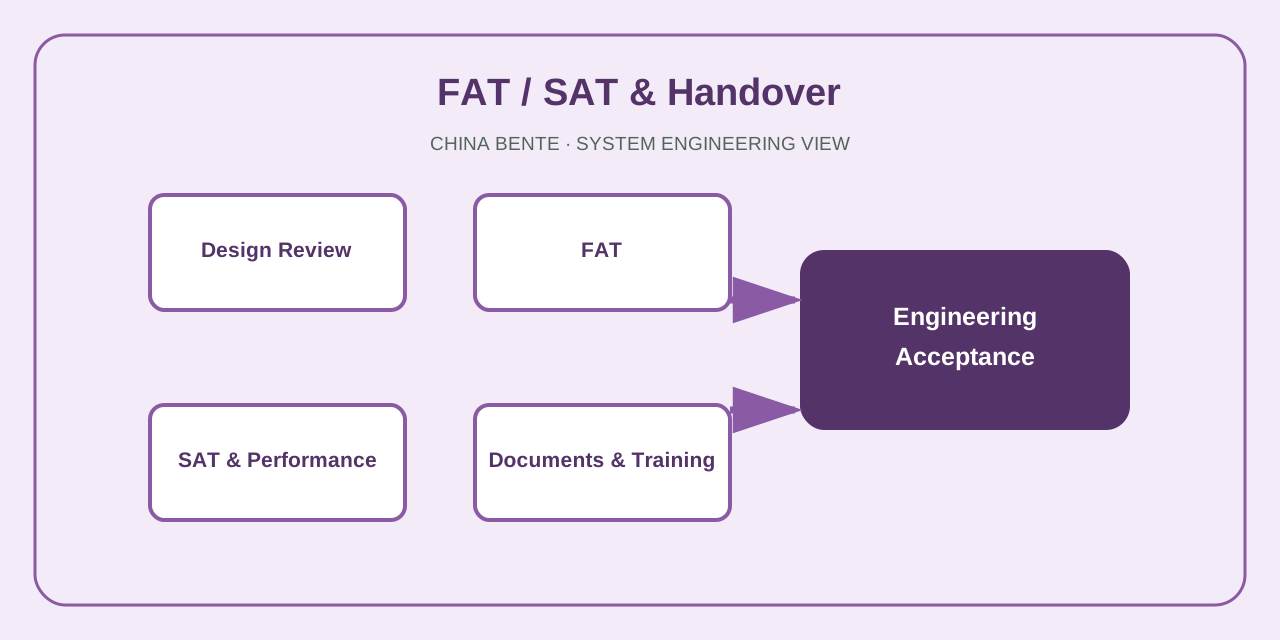
FAT, SAT, commissioning and data handover turn design intent into verified operation. The work defines what can be proven off-site, what requires field equipment or process material, how defects are controlled and exactly which source, configuration, records and ownership must be delivered.
Applications and Operating Objectives
Applications include PLC/HMI/SCADA, MES, networks, smart logistics, energy and environmental monitoring, package-machine integration, control migration and multi-vendor digital systems.
System Workflow and Architecture
The test architecture includes simulators, stubs, representative devices and controlled test data. Defects have severity, owner, target and retest evidence; passed FAT does not replace required site testing.
Main Equipment and Software Components
Tools may include I/O and protocol simulators, test benches, network analyzers, calibrated references, issue tracker, evidence repository, backup/configuration utilities and secure transfer media.
Capacity and Design Basis
Planning uses requirement and interface lists, system criticality, configuration baseline, vendor boundaries, test environment, site readiness, operating material and acceptance authority.
| Operational scale | Requirements, I/O/tags, screens, alarms, interfaces, user roles, failure scenarios, test cases, defects and handover artifacts are counted and traced. |
|---|---|
| Interfaces | Vendor packages, PLC/SCADA/MES, networks, instruments, drives, enterprise systems and owner repositories have explicit test and handover boundaries. |
| Acceptance performance | Acceptance requires approved procedures, objective evidence, resolved or accepted defects, versioned baseline, successful backups/restores where required and signed authority. |
| Unknown/TBC | Unverified counts, latency, accuracy, availability, savings and integration assumptions remain TBC until survey and testing. |
Utilities and Infrastructure
FAT test space and power, simulators, secure connectivity, site utilities/readiness, calibrated tools, test data, witness access and document repository are arranged.
Required Customer Engineering Inputs
Customers provide approved requirements, process narratives, I/O/tags, cause-and-effect, interface specs, user roles, site readiness, acceptance criteria, witness authority and document standards.
Data, Automation and Control
Test scripts include commands, permissives, interlocks, alarms, modes, communication loss, restart and correction handling. UNKNOWN prerequisites remain open, not converted into passed tests.
Cybersecurity and Access Control
Test credentials and remote sessions are temporary and controlled. Production secrets use protected transfer; evidence is sanitized and final owner accounts/backups are confirmed.
CAPEX and OPEX Drivers
Cost depends on system and interface scale, simulation depth, witness cycles, site travel, readiness delays, retesting and documentation recovery. Early traceability reduces late rework.
Safety, Compliance and Lifecycle
Commissioning uses permits, energization boundaries, lockout, safe states, hold points and authorized decision makers. Production material tests occur only under approved operating plans.
Outputs and Acceptance Basis
Outputs include requirements traceability, approved FAT/SAT scripts, witnessed records, defect and retest log, commissioning plan/results, final versions, source/configuration/backups, licenses, as-builts, training and acceptance certificate.
Implementation and Commissioning
Planning starts before build, with progressive internal tests, formal FAT, readiness review, staged SAT and commissioning, stabilization, final backup capture and artifact-by-artifact handover verification.
Project Evidence
Frequently Asked Questions
What is the difference between FAT and SAT?
FAT verifies configured system functions before shipment or deployment; SAT verifies installation and site-specific operation.
Can FAT replace commissioning?
No. Field wiring, instruments, networks, equipment and real process behavior require site tests.
Who approves test procedures?
The contract-defined owner and relevant engineering/safety stakeholders approve scope, criteria and witness roles.
How are defects controlled?
Each defect has severity, evidence, owner, disposition and retest status; open items are not silently treated as passed.
What if a prerequisite is missing?
The affected test remains blocked/TBC and is rescheduled or formally dispositioned.
Should backup restoration be tested?
For critical systems, an agreed restore test or evidence is essential to prove recoverability.
What data must be handed over?
Source, configurations, final backups, licenses, tag and interface data, as-builts, tests, manuals, training and access under owner control.
When is commissioning complete?
After required tests and stabilization, defect disposition, final baseline capture, handover verification and authorized acceptance.
Related Engineering Links
Smart & Intelligent Solutions overview · AI Vision Inspection · Digital Twin & Data Platform · Projects & Cases · Request a Project Evaluation
Request a Project Evaluation
Provide system inventory, network and control drawings, data samples, user and security requirements, existing backups, operational constraints and acceptance priorities. Unknown information may remain TBC.