BEFORE
Manual and fragmented
Operators move material between isolated machines; settings, quality records and WIP status are disconnected.
 CHINA BENTEINDUSTRY GROUP
System-level modernization of metal processing and fabrication lines from manual handling and isolated machines to integrated automated production.
Modernize the complete metal-production system—not simply one machine. The engineering path connects coil, sheet or profile handling; forming and cutting; welding or joining; inspection; traceability; safety; and production control around a defined product family and acceptance basis.
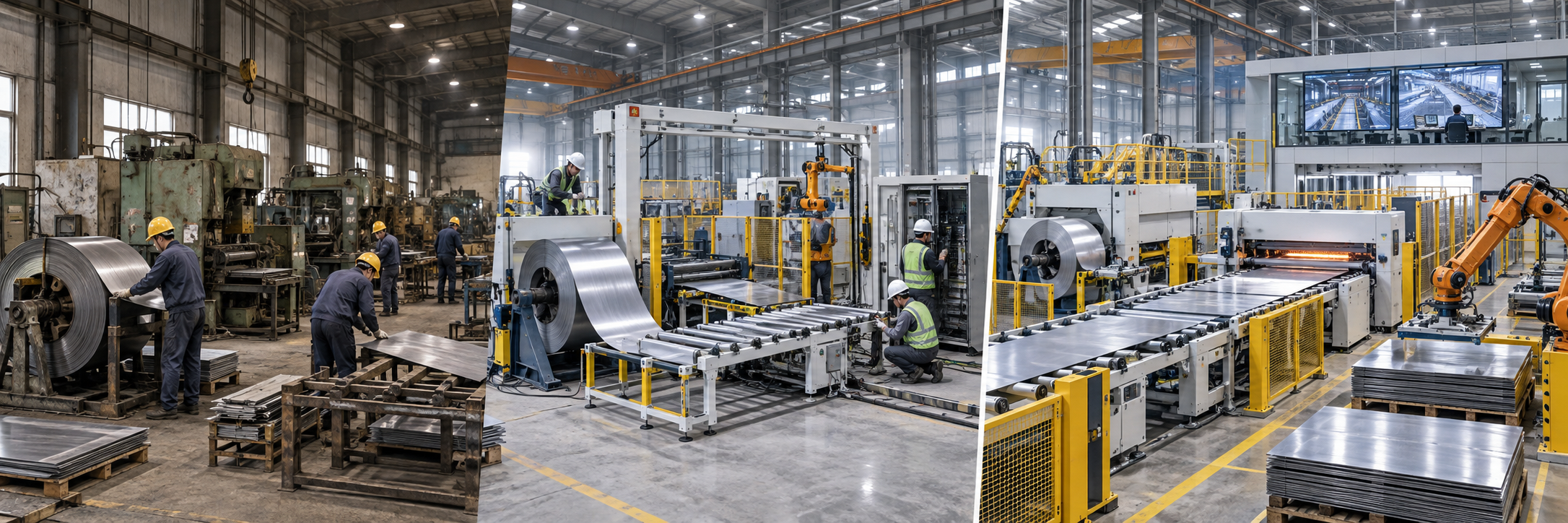
BEFORE
Operators move material between isolated machines; settings, quality records and WIP status are disconnected.
RETROFIT
Retained assets receive engineered transfer, guarding, sensors, drives, fixtures, PLC interfaces and common line logic.
AUTOMATED
Automated feeding, processing, robotic handling, in-line inspection and production data operate as one controlled system.
Yes, when condition, capability, safety and interface checks confirm that they can support the target products and operating sequence. Retention is an engineering decision, not an assumption.
The design may combine loaders, roller tables, conveyors, robots, buffers and identification controls. The choice depends on material geometry, weight, surface protection, takt and building constraints.
They can be integrated where mechanical, electrical, communication, safety and timing interfaces are known or can be engineered. Interface testing is included in the FAT and SAT plan.
Product families, tooling, recipes, datum control and verification steps are defined so changeovers are repeatable. The achievable method and time depend on the actual product range and retained equipment.
Options include dimensional gauging, presence checks, seam or weld inspection, surface vision, weight checks and traceability. The inspection plan follows the product acceptance criteria.
Risk assessment drives guarding, controlled access, interlocks, safe speed, emergency stops, isolation points and validated safety functions. Residual tasks and responsibilities are documented.
Not necessarily. Surveys, fabrication, panel build and testing can often be completed in advance, while tie-ins and final validation require planned production interruption.
The contract should define products, materials, utilities, staffing, test duration, measurement method, exclusions and upstream/downstream conditions before any performance criterion is binding.
Provide product drawings, material range, process route, equipment and control details, layout, losses, utilities, target operating conditions and available shutdown windows.