China Bente Industry Group logoCHINA BENTEINDUSTRY GROUP
Menu
China Bente Industry Group

Metal Processing & Fabrication Modernization

System-level modernization of metal processing and fabrication lines from manual handling and isolated machines to integrated automated production.

Modernize the complete metal-production system—not simply one machine. The engineering path connects coil, sheet or profile handling; forming and cutting; welding or joining; inspection; traceability; safety; and production control around a defined product family and acceptance basis.

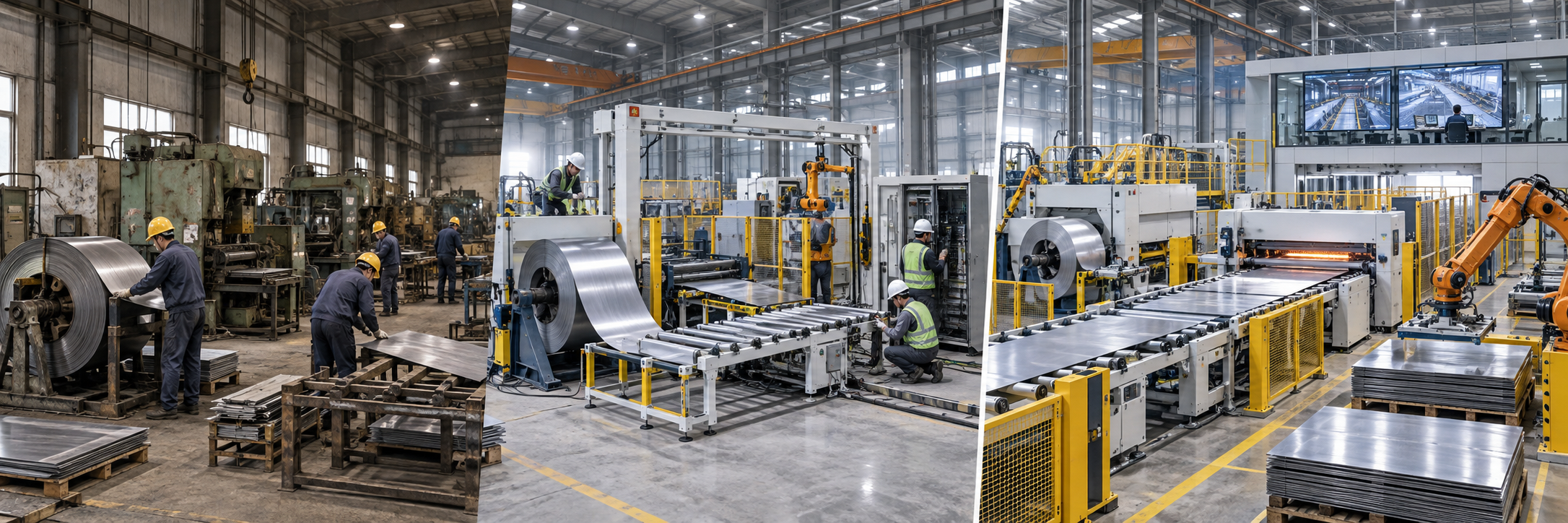
Before / Retrofit / Automated

Metal processing factory transformation from manual handling through retrofit to an integrated automated line

BEFORE

Manual and fragmented

Operators move material between isolated machines; settings, quality records and WIP status are disconnected.

RETROFIT

Integrated in controlled phases

Retained assets receive engineered transfer, guarding, sensors, drives, fixtures, PLC interfaces and common line logic.

AUTOMATED

Continuous and traceable

Automated feeding, processing, robotic handling, in-line inspection and production data operate as one controlled system.

Applicable factories and typical legacy-system problems

  • Applicable factories: coil and sheet processing, profiles and tubes, laser/plasma cutting, press and forming shops, welding cells, fabrication lines and finishing operations.
  • Typical problems: repeated crane or forklift transfers, manual alignment, long changeovers, variable fixtures, isolated CNC/PLC controls, unsafe access, WIP accumulation and inspection after defects have already propagated.
  • Upgrade boundary: confirmed from incoming material and identification through finished-part transfer, including retained-machine interfaces and off-line operations that constrain line flow.

Metal line modernization process flow

01Material identificationCoil, sheet or profile verification
02Automated infeedDecoiling, straightening, feeding or loading
03Primary processingCutting, punching, forming or machining
04Joining cellRobotic or controlled welding and assembly
05In-line qualityDimension, seam and surface checks
06Sorting and handoffStacking, marking, traceability and dispatch

Modernization scope

  • Survey the real material route, cycle losses, retained-machine condition, controls, tooling, inspection points and operator interventions.
  • Define which assets are retained, rebuilt, bypassed or replaced; freeze mechanical, electrical, data, safety and material-transfer interfaces.
  • Engineer automated loading/unloading, buffers, fixtures, conveyors or roller tables, guarding, extraction and maintenance access.
  • Integrate line PLC, cell controllers, HMI/SCADA, production recipes, traceability and quality signals without assuming unsupported compatibility.

Metal-production system architecture

Material-flow layer

Infeed, buffers, roller tables, robots, transfer devices, finished-part stacking and scrap handling.

Process-equipment layer

Cutting, punching, forming, machining, welding, grinding, coating or other retained and new process cells.

Control and safety layer

PLC, CNC/cell controllers, remote I/O, drives, safety PLC/relays, interlocks, light curtains and access control.

Operations and data layer

HMI/SCADA, recipes, work-order status, downtime, quality records, traceability and maintenance diagnostics.

Main equipment and automation systems

  • Coil cars, decoilers, straighteners, feeders, loaders, roller tables, conveyors, buffers and robotic handling selected for the actual product envelope.
  • Laser/plasma cutting, presses, bending/forming, machining, welding and finishing equipment within the agreed retained/new asset boundary.
  • Servo systems, VFDs, PLC and remote I/O, HMI/SCADA, industrial networks, barcode/RFID, machine vision, gauging and safety systems.

Engineering inputs required from the customer

  • Product drawings, material grades, thickness/section range, tolerances, weld or finish specifications and planned product mix.
  • Current and target output by product, cycle-time and downtime history, scrap/rework data, changeover practice and shift pattern.
  • Equipment list, controller/software versions, electrical drawings, layouts, foundations, lifting constraints, maintenance records and available backups.

Utilities and interfaces

  • Electrical load and power quality, compressed air, shielding/process gases, extraction and filtration, cooling water, ventilation and fire protection.
  • Mechanical datum and transfer heights, crane/forklift routes, scrap removal, network and data interfaces, upstream/downstream buffers and building clearances.

Shutdown, installation, commissioning and changeover

  • Complete scanning, interface measurement, software backup, panel build, fixture trials and off-site testing before the outage where practicable.
  • Use an approved isolation and tie-in register, work-front plan, lifting/access plan, inspection hold points and defined rollback or temporary-production conditions.
  • Execute cold checks, dry cycles, guarded low-speed trials, product trials, operator training and controlled production ramp-up before handover.

FAT, SAT and performance acceptance boundary

  • FAT: panel and software checks, simulated I/O, sequence/interlock review, safety logic, recipe handling and documented exceptions before shipment.
  • SAT: installed I/O and direction checks, safeguarding validation, transfer synchronization, alarms, traceability and trials using agreed materials.
  • Performance: evaluated only against an agreed product mix, material specification, staffing, utilities, upstream/downstream readiness and test duration; no output or yield figure is promised before those conditions are defined.

CAPEX and OPEX impact factors

  • CAPEX factors: retained-asset condition, product range, automation depth, guarding, tooling, controls migration, building work, utilities, installation access, spares and validation scope.
  • OPEX factors: labour deployment, consumables, scrap/rework, energy, maintenance skills, tooling life, planned downtime, software support and spare-parts strategy.

Metal processing modernization FAQ

Can existing presses, lasers or CNC machines be retained?

Yes, when condition, capability, safety and interface checks confirm that they can support the target products and operating sequence. Retention is an engineering decision, not an assumption.

How is manual material handling automated?

The design may combine loaders, roller tables, conveyors, robots, buffers and identification controls. The choice depends on material geometry, weight, surface protection, takt and building constraints.

Can machines from different suppliers run as one line?

They can be integrated where mechanical, electrical, communication, safety and timing interfaces are known or can be engineered. Interface testing is included in the FAT and SAT plan.

How are changeovers handled after modernization?

Product families, tooling, recipes, datum control and verification steps are defined so changeovers are repeatable. The achievable method and time depend on the actual product range and retained equipment.

What quality checks can be placed in line?

Options include dimensional gauging, presence checks, seam or weld inspection, surface vision, weight checks and traceability. The inspection plan follows the product acceptance criteria.

How is operator safety improved?

Risk assessment drives guarding, controlled access, interlocks, safe speed, emergency stops, isolation points and validated safety functions. Residual tasks and responsibilities are documented.

Must the factory stop for the entire retrofit?

Not necessarily. Surveys, fabrication, panel build and testing can often be completed in advance, while tie-ins and final validation require planned production interruption.

What defines successful performance acceptance?

The contract should define products, materials, utilities, staffing, test duration, measurement method, exclusions and upstream/downstream conditions before any performance criterion is binding.

What information is needed for an initial study?

Provide product drawings, material range, process route, equipment and control details, layout, losses, utilities, target operating conditions and available shutdown windows.