China Bente Industry Group logoCHINA BENTEINDUSTRY GROUP
Menu
China Bente Industry Group

Agricultural & Food Processing Modernization

System-level modernization of agricultural and food processing from manual batching and isolated equipment to hygienic automated production, packaging and traceability.

Upgrade the complete agricultural or food-production system from receiving and preparation through processing, filling or packing, cleaning and traceability. The modernization boundary is defined by product safety, recipe control, hygienic design and the actual operating environment.

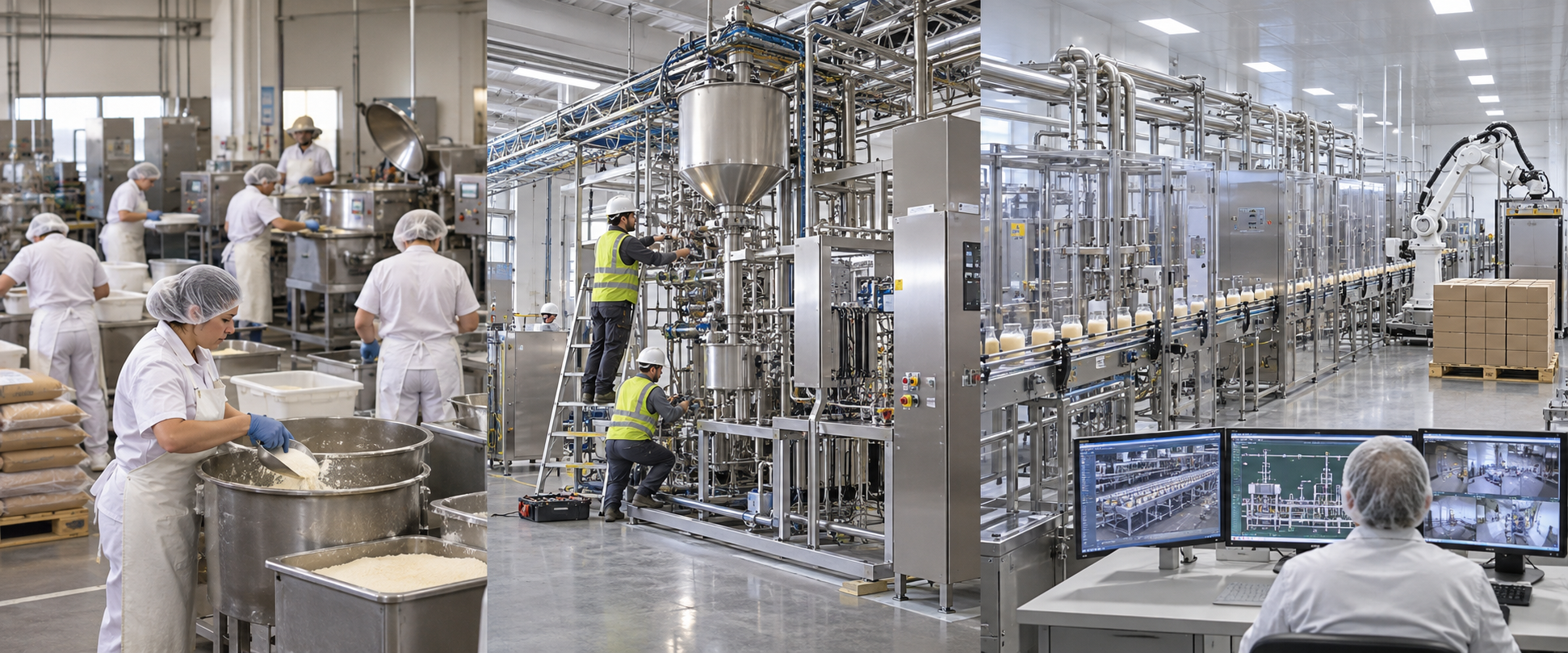
Before / Retrofit / Automated

Food processing factory transformation from manual batching through hygienic retrofit to automated processing and packaging

BEFORE

Manual batching and disconnected records

Ingredients are weighed and moved manually; separate machines depend on operator timing and paper-based checks.

RETROFIT

Hygienic integration

Enclosed transfer, automatic dosing, instruments, valves, cleanable pipework and control panels connect retained and new process equipment.

AUTOMATED

Recipe-controlled production

Receiving, dosing, processing, filling, packing, CIP and traceability are coordinated through validated recipes and production states.

Applicable factories and typical legacy-system problems

  • Applicable factories: grain and feed preparation, milling, dairy and beverage, sauces and liquid foods, bakery ingredients, fruit/vegetable processing, filling, packing and cold-chain interfaces.
  • Typical problems: manual weighing, open transfers, recipe variation, contamination risks, weak allergen segregation, unrecorded cleaning, isolated packaging equipment and limited lot traceability.
  • Upgrade boundary: raw-material receiving and storage through processing, packing, cleaning and production records, with food-safety responsibilities and excluded laboratory functions clearly stated.

Agricultural and food line process flow

01Receiving and verificationRaw-material identity and condition
02Storage and dosingSilos, tanks, bins, weighing and recipe issue
03PreparationCleaning, milling, mixing or pre-treatment
04Controlled processingThermal, separation, fermentation or forming step
05Filling and packagingEnclosed transfer, inspection and pack coding
06Cleaning and traceabilityCIP states, lot genealogy and release records

Modernization scope

  • Map ingredients, products, allergens, rework, personnel, waste and cleaning routes before fixing the modernization boundary.
  • Assess hygienic condition, cleanability, dead legs, cross-contact risks, material compatibility, instrumentation, temperature control and packaging interfaces.
  • Engineer automated receiving, dosing, mixing, process sequencing, filling/packing handoff, CIP and production-state control around approved recipes.
  • Define retained equipment, sanitary tie-ins, utilities, food-safety hold points, verification responsibilities and production-release authority.

Food-production system architecture

Ingredient and material layer

Receiving, silos, tanks, bins, conveying, weighing, dosing and controlled additions.

Hygienic process layer

Cleaning, milling, mixing, thermal processing, separation, fermentation, holding and enclosed transfer as applicable.

Packaging and sanitation layer

Filling, sealing, coding, inspection, case packing, palletizing, CIP circuits and sanitation states.

Control and traceability layer

PLC, batch/recipe control, HMI/SCADA, lot genealogy, critical-process records, alarms and production reporting.

Main equipment and automation systems

  • Receivers, cleaners, mills, conveyors, silos, tanks, load cells, feeders, mixers, pumps, hygienic valves, heat exchangers and process skids selected for the product.
  • Fillers, sealers, label/coding systems, checkweighers, inspection systems, case packers, palletizers and controlled packaging interfaces.
  • PLC and remote I/O, batch/recipe management, HMI/SCADA, instruments, hygienic sensors, CIP controls, historian and traceability interfaces.

Engineering inputs required from the customer

  • Product and ingredient specifications, recipes, allergen matrix, food-safety plan, cleaning standards, packaging formats, shelf-life controls and required records.
  • Current and target production by product, batch sizes, changeover/cleaning times, losses, downtime, microbiological or quality hold points and staffing.
  • Process flow, piping and instrumentation information, equipment list, layout and zoning, utility data, drainage, ventilation, cold-chain and control backups.

Utilities and interfaces

  • Potable/process water, steam or thermal fluid, chilled/cooling water, refrigeration, compressed air quality, clean gases, electrical supply, drainage, effluent and ventilation.
  • Hygienic zoning, personnel and material access, CIP supply/return, waste and by-product routes, laboratory/release interfaces, packaging supply and cold storage.

Shutdown, installation, commissioning and changeover

  • Schedule tie-ins around product campaigns, sanitation windows, shelf-life constraints and raw-material commitments; prebuild skids, pipe spools and panels where feasible.
  • Control hygienic isolation, temporary services, clean construction, foreign-material prevention, cleaning verification and documented line clearance.
  • Commission with water or approved surrogate where appropriate, then recipe and product trials, sanitation verification, traceability tests, training and authorized production release.

FAT, SAT and performance acceptance boundary

  • FAT: skid and panel functions, recipe sequences, valve matrices, simulated instruments, alarm/interlock review, records and agreed cleanability documentation.
  • SAT: installation checks, utilities, flow paths, instrument calibration, CIP sequences, packaging interfaces, traceability challenge and approved product trials.
  • Performance: criteria are conditional on defined ingredients, recipe, packaging, utilities, sanitation state, staffing, upstream/downstream availability and test duration; food-safety release remains with the agreed responsible party.

CAPEX and OPEX impact factors

  • CAPEX factors: hygienic grade, product/allergen segregation, automation depth, sanitary piping, CIP, thermal/refrigeration duty, packaging formats, building zoning, validation and production continuity.
  • OPEX factors: labour deployment, ingredients and giveaway, water/energy/chemicals, cleaning time, packaging loss, maintenance, refrigeration, quality holds and traceability administration.

Agricultural and food processing modernization FAQ

Can an operating food factory be modernized in phases?

Yes, when hygienic boundaries, temporary flows, cleaning, traceability and release conditions are defined for every phase. Product-safety controls cannot be deferred.

Can existing tanks, mixers or fillers be retained?

They may be retained after checking condition, material compatibility, cleanability, capacity, controls and food-safety requirements against the intended products.

How is manual recipe dosing automated?

The system can use controlled storage, load cells, feeders, meters, valves, barcode checks and recipe permissions. The selected method depends on ingredient behavior, accuracy and contamination risk.

Is CIP always part of the upgrade?

CIP is assessed wherever product-contact equipment requires controlled cleaning. The final boundary depends on the process, existing sanitation method, circuits and verification requirements.

How are allergens and cross-contact risks handled?

The design reviews segregation, scheduling, dedicated or shared equipment, transfer routes, cleaning validation, line clearance and traceability according to the customer’s food-safety plan.

Can packaging lines be integrated with process automation?

Yes. Buffering, permissives, speed coordination, coding, inspection and lot data can connect processing and packaging when interface details are available.

What utilities most often limit a food-line upgrade?

Steam or heating duty, refrigeration, process water, compressed-air quality, drainage, effluent capacity and electrical distribution often require verification before the target operating plan is accepted.

How is traceability tested?

An agreed challenge follows material lots, recipes, process states, packaging codes, holds and rework through the defined system, with exceptions recorded and resolved.

Can throughput or yield be guaranteed during an initial study?

No. Binding criteria require verified product data, recipe, raw-material variation, utilities, packaging, sanitation, staffing and test conditions. The initial study defines how they will be measured.