China Bente Industry Group logoCHINA BENTEINDUSTRY GROUP
Menu
China Bente Industry Group

Building Materials Manufacturing Modernization

System-level modernization of building-material production from manual batching and fragmented controls to integrated automated crushing, dosing, forming, curing and packaging.

Modernize the complete building-material production system—from raw-material receiving and preparation through dosing, forming or thermal processing, finishing and dispatch. The upgrade balances heavy-duty process equipment, dust control, quality feedback, utilities and central control.

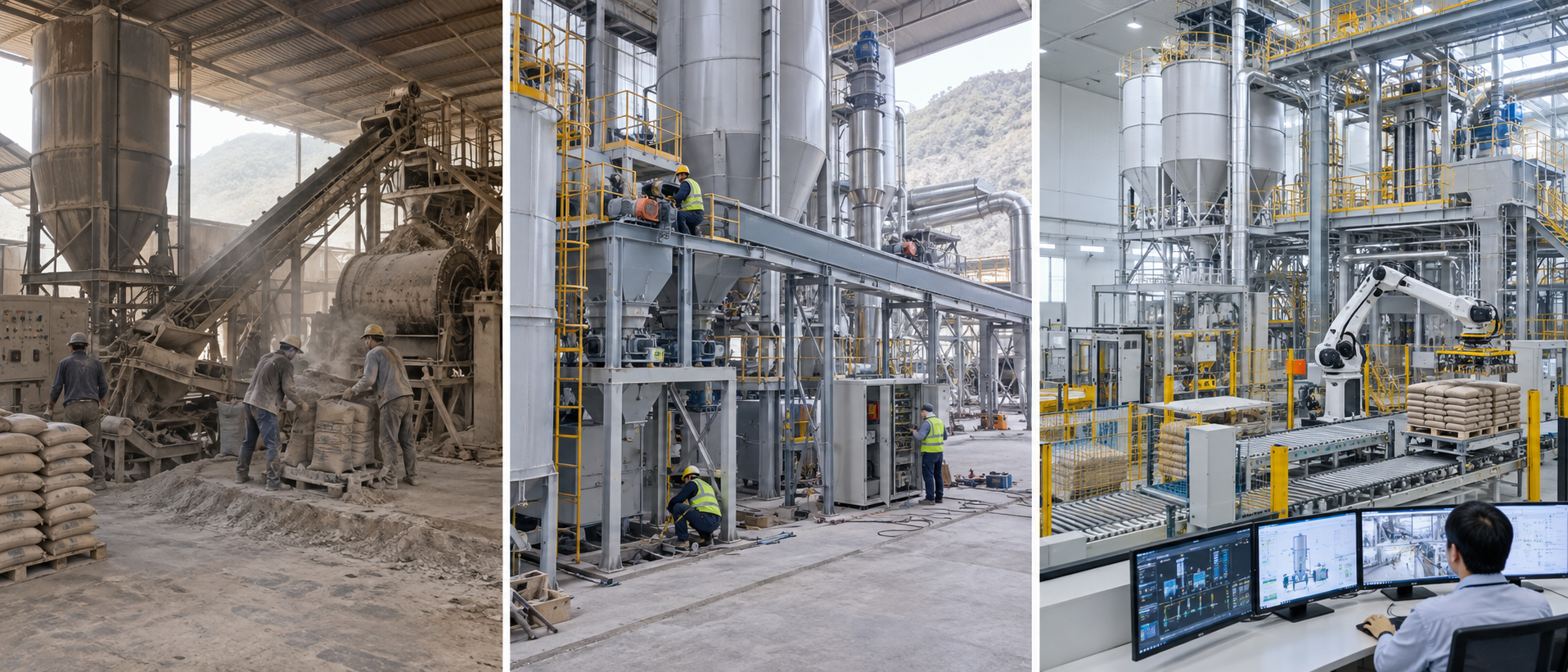
Before / Retrofit / Automated

Building materials factory transformation from manual batching through retrofit to automated production and packing

BEFORE

Manual adjustments and isolated machines

Operators regulate feed, moisture and machine settings locally while material flow and quality data remain fragmented.

RETROFIT

Measured and synchronized

Weighing, feeders, drives, dust extraction, conveyors, sensors and PLC controls are added around retained process equipment.

AUTOMATED

Integrated process and dispatch

Raw-material preparation, dosing, processing, forming or firing, inspection, palletizing and production reporting work as one controlled line.

Applicable factories and typical legacy-system problems

  • Applicable factories: concrete products and blocks, dry mortar and mixes, gypsum products, cementitious materials, aggregates, boards, tiles, bricks and related mineral-product lines.
  • Typical problems: inconsistent feed, manual batching, moisture variation, dust escape, overloaded conveyors, local-only controls, kiln or curing instability, high breakage and packaging bottlenecks.
  • Upgrade boundary: quarry or received material handoff through preparation, dosing, processing, forming/curing/firing, inspection, palletizing and dispatch interfaces as applicable.

Building-material line process flow

01Raw-material receivingHoppers, stock and identity control
02PreparationCrushing, screening, drying or milling
03Dosing and blendingWeighing, moisture correction and mixing
04Product formationPressing, extrusion, casting or shaping
05Curing or thermal stageControlled residence, temperature or moisture
06Finish and dispatchInspection, palletizing, wrapping and production records

Modernization scope

  • Measure real feed characteristics, moisture, particle-size distribution, equipment condition, material balances, recirculation and dust-emission points.
  • Define retained crushers, mills, mixers, presses, extruders, kilns, curing systems and packaging equipment; freeze process and transfer interfaces.
  • Engineer controlled feeding, weighing, moisture correction, conveying, buffering, dust collection, automated handling and quality sampling.
  • Integrate local machine controls into coordinated PLC/SCADA sequences with permissives, alarms, recipes, energy data and maintenance diagnostics.

Building-material production system architecture

Bulk-material layer

Hoppers, crushers, screens, mills, dryers, silos, feeders, conveyors, elevators and dust collection.

Process and forming layer

Weighing, blending, mixers, presses, extruders, moulds, kilns, dryers, autoclaves or curing systems as applicable.

Finishing and logistics layer

Cutting, surface treatment, inspection, stacking, palletizing, wrapping, storage and dispatch handoff.

Control and optimization layer

PLC/SCADA, drives, weighing control, moisture/temperature instruments, recipes, quality feedback, historian and maintenance data.

Main equipment and automation systems

  • Hoppers, feeders, crushers, screens, mills, dryers, silos, pneumatic or mechanical conveying, elevators and dust-collection systems.
  • Weighing and dosing, mixers, presses, extruders, mould handling, kilns, burners, curing chambers, autoclaves, cutters and finishing equipment as applicable.
  • PLC and remote I/O, HMI/SCADA, VFDs, weigh controllers, moisture/temperature/pressure instruments, analyzers, machine vision and automated palletizing.

Engineering inputs required from the customer

  • Raw-material properties and variation, formulations, product dimensions and grades, strength or finish criteria, permitted rework and packaging formats.
  • Current and target production by product, mass balance, downtime, rejects/breakage, energy and fuel use, dust-control data and maintenance history.
  • Equipment and control inventory, layouts/elevations, foundations, structures, utilities, environmental permits, material routes and shutdown windows.

Utilities and interfaces

  • Electrical distribution and motor starting, fuel and combustion air, compressed air, water and moisture control, steam where used, ventilation, dust extraction and fire systems.
  • Foundations and dynamic loads, structures and access, transfer elevations, storage capacity, mobile-equipment routes, waste/recycle loops and upstream/downstream logistics.

Shutdown, installation, commissioning and changeover

  • Use surveys, wear measurements, scans, structural checks, prefabricated chutes/ducts, panel build and dry testing to reduce work inside the outage.
  • Coordinate isolation of electrical, mechanical, stored-energy, fuel, hot-work and confined-space hazards with demolition, lifting, refractory/curing and environmental controls.
  • Commission from no-load rotation and interlocks through material introduction, mass-balance stabilization, recipe trials, dust checks, quality sampling and controlled ramp-up.

FAT, SAT and performance acceptance boundary

  • FAT: panels, PLC/SCADA sequences, drive and weigh-control simulation, permissives, alarms, recipe handling and selected equipment tests before delivery.
  • SAT: installed rotation, alignment, load-cell calibration, transfer and dust integrity, burner/thermal checks where applicable, safety validation and material trials.
  • Performance: assessed against agreed raw-material properties, product mix, recipe, utilities, environmental conditions, operating crew, test duration and quality method; no capacity or energy value is binding without that basis.

CAPEX and OPEX impact factors

  • CAPEX factors: retained heavy-equipment condition, foundations/structures, wear protection, automation depth, dust and environmental controls, fuel/thermal systems, installation access, storage and packaging.
  • OPEX factors: power and fuel, wear parts, maintenance access, raw-material variation, recirculation, rejects, dust handling, labour deployment, changeovers and packaging losses.

Building materials modernization FAQ

Which building-material factories can be modernized?

Typical candidates include concrete products, blocks, dry mixes, gypsum, cementitious products, aggregates, boards, tiles and bricks. The process and product specification determine the actual scope.

Can crushers, mills, mixers or presses be retained?

Yes, after condition, capacity, wear, safety, control and interface checks show that the equipment can support the target operating envelope and product quality.

How is raw-material variation handled?

The upgrade may add controlled storage, weighing, moisture measurement, feeders, blending logic, sampling and recipe correction. Control limits require representative material data.

Can dust control be upgraded with the production line?

Yes. Capture points, ducting, air balance, filters, discharge and housekeeping interfaces should be engineered together with material transfers and production states.

How are kilns, dryers or curing systems integrated?

Their fuel, airflow, temperature, residence-time, safety and product interfaces are mapped into the line controls. Thermal acceptance requires defined product and operating conditions.

What limits capacity in an older building-material line?

Feed preparation, conveying, storage, weighing, mixing, forming, thermal residence, curing space, finishing or packing may each become the constraint. Measurement is needed before selecting equipment.

Can installation be completed during a planned shutdown?

It may be feasible when surveys, prefabrication, access, lifting, structural work, isolations, curing times, resources and contingency are resolved before the outage.

How are quality and performance accepted?

The plan defines sampling, test standards, raw-material envelope, product mix, test duration, operating conditions and responsibility for laboratory results before trials begin.

How are CAPEX and OPEX compared?

Options are compared on engineering scope, retained-asset risk, installation, utilities, wear, energy, maintenance, labour, quality loss and lifecycle support rather than an unverified headline saving.