
Factory Modernization
How existing plants cut energy, water and waste without a full rebuild.
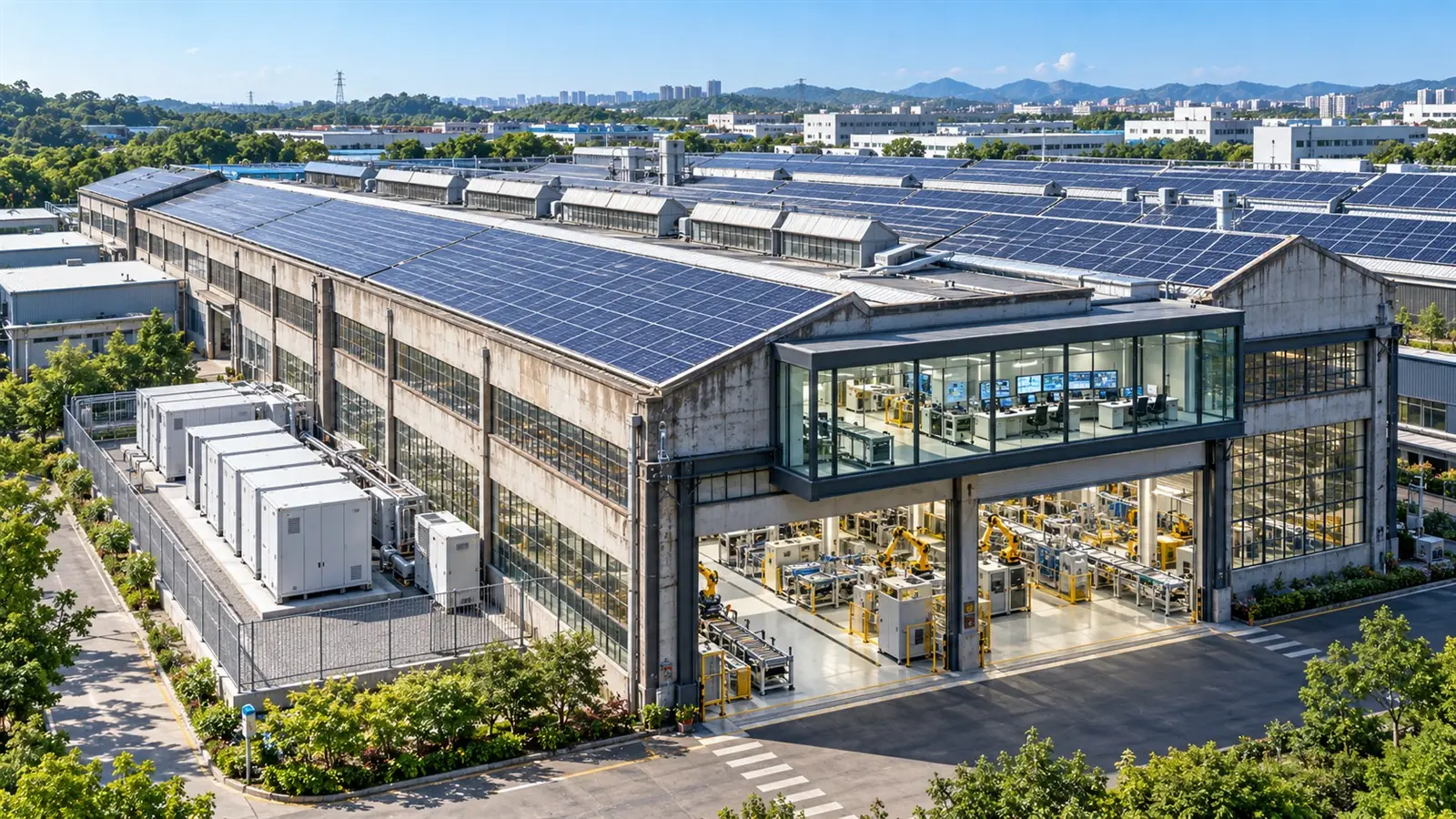
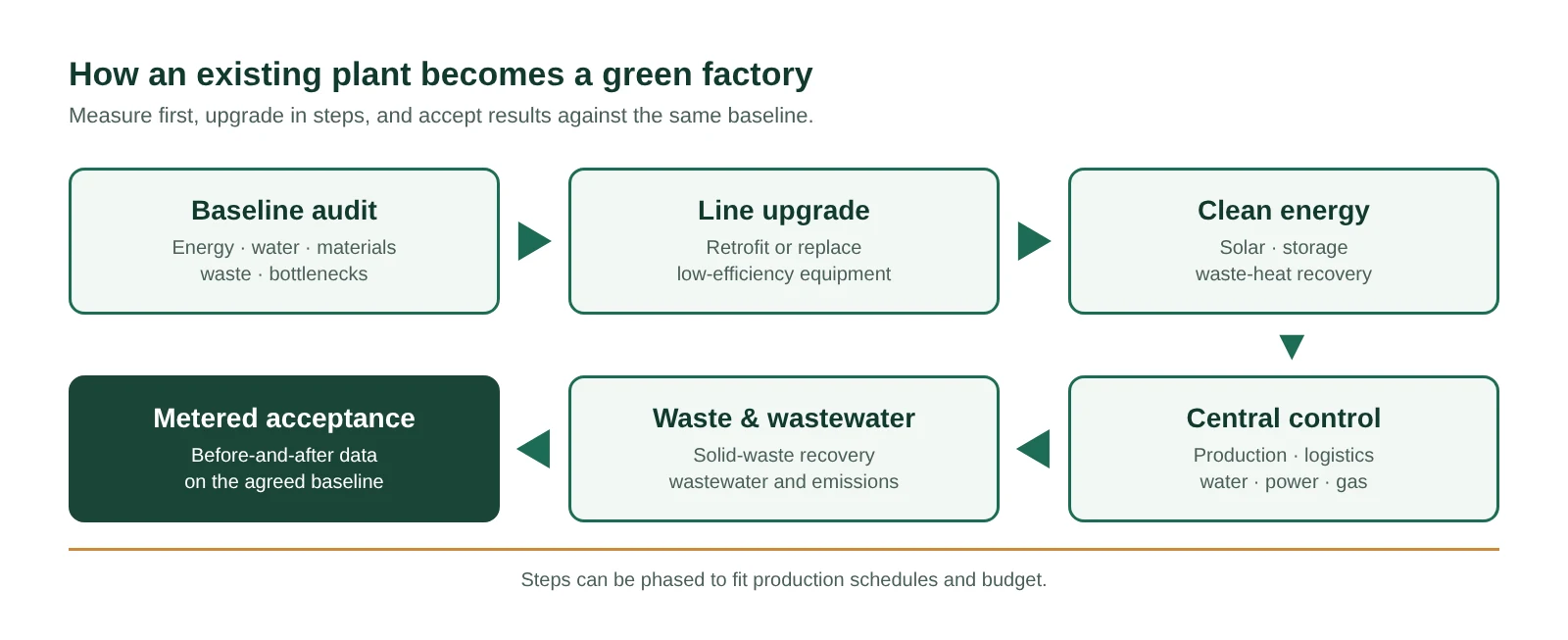
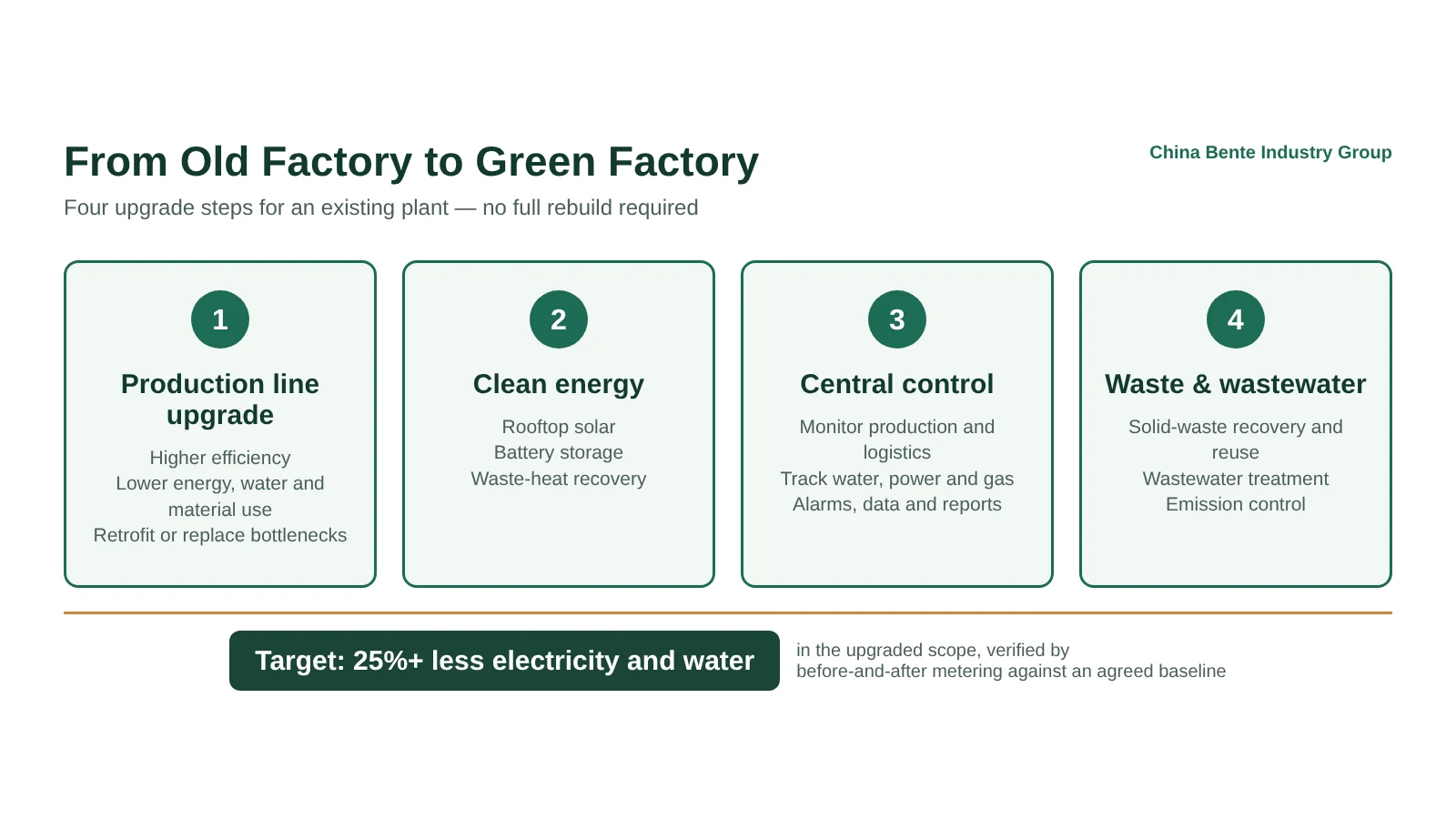
Yes. Most existing factories do not need to be demolished and rebuilt to become green factories. The usual path has four steps: upgrade or replace inefficient production lines; add solar and other clean energy; install central control to monitor production, logistics, water, power and gas; and treat and recover solid waste, wastewater and emissions. For the scope we upgrade, China Bente works to a target of at least 25% less electricity and water use, verified by before-and-after metering.
This matters because energy, water and waste costs keep rising, and buyers, regulators and export customers increasingly ask for evidence of cleaner production. The challenge for an old plant is not knowing what "green" means — it is deciding where to start, what to do first, and how to prove the result.
What makes a factory "green"?
A green factory produces the same or more output with less energy, water, material and waste, and can show this with measured data. It is not a label for one machine or one solar roof. It combines efficient production equipment, cleaner energy supply, visibility of consumption, and responsible treatment of everything that leaves the plant as waste, wastewater or emissions.
For an existing plant, the practical definition is simple: every upgrade should reduce consumption or waste against a measured baseline, and the improvement should be visible in the plant's own meters and records.
Step 1 — Should I upgrade my existing line or buy a new one?
Start with the bottlenecks and the biggest consumers, not with a full replacement. Many older lines can be retrofitted: high-efficiency motors and drives, better process control, heat recovery, leak repair, improved material handling and replacement of single bottleneck machines. A new line is justified when the old one cannot reach the required quality, capacity or efficiency at a reasonable retrofit cost.
The decision should compare retrofit and replacement on the same basis: output, energy and water per unit, downtime during the change, and remaining equipment life. See Factory Upgrade & Retrofit, Energy Efficiency Retrofit and, for new lines, Industrial Machinery & Production Lines.
Step 2 — Can my factory run on solar and other clean energy?
Most factories can cover part of their daytime demand with rooftop or ground-mounted solar. Battery storage can shift solar energy into evening shifts or reduce peak demand, and waste-heat recovery can turn process heat into useful hot water or steam. How much of the load clean energy can cover depends on roof or land area, daily load profile, grid conditions and local rules.
Size the system from the plant's real load data — hourly or at least monthly consumption — rather than from roof area alone. See Renewable & Clean Energy and Solar + BESS Hybrid Systems.
Step 3 — How does central control cut water, power and gas use?
You cannot reduce what you cannot see. A central control system brings production, logistics and utility data onto one screen: line status, output, stoppages, and the consumption of water, electricity, gas and compressed air by area or by machine. Operators and managers can then find idle running, leaks, peaks and inefficient settings, and act on them every shift.
Central control is also what makes the savings provable, because the same meters that guide daily operation record the before-and-after result. See Smart Factory Systems and Energy Monitoring & Management.
Step 4 — What happens to waste, wastewater and emissions?
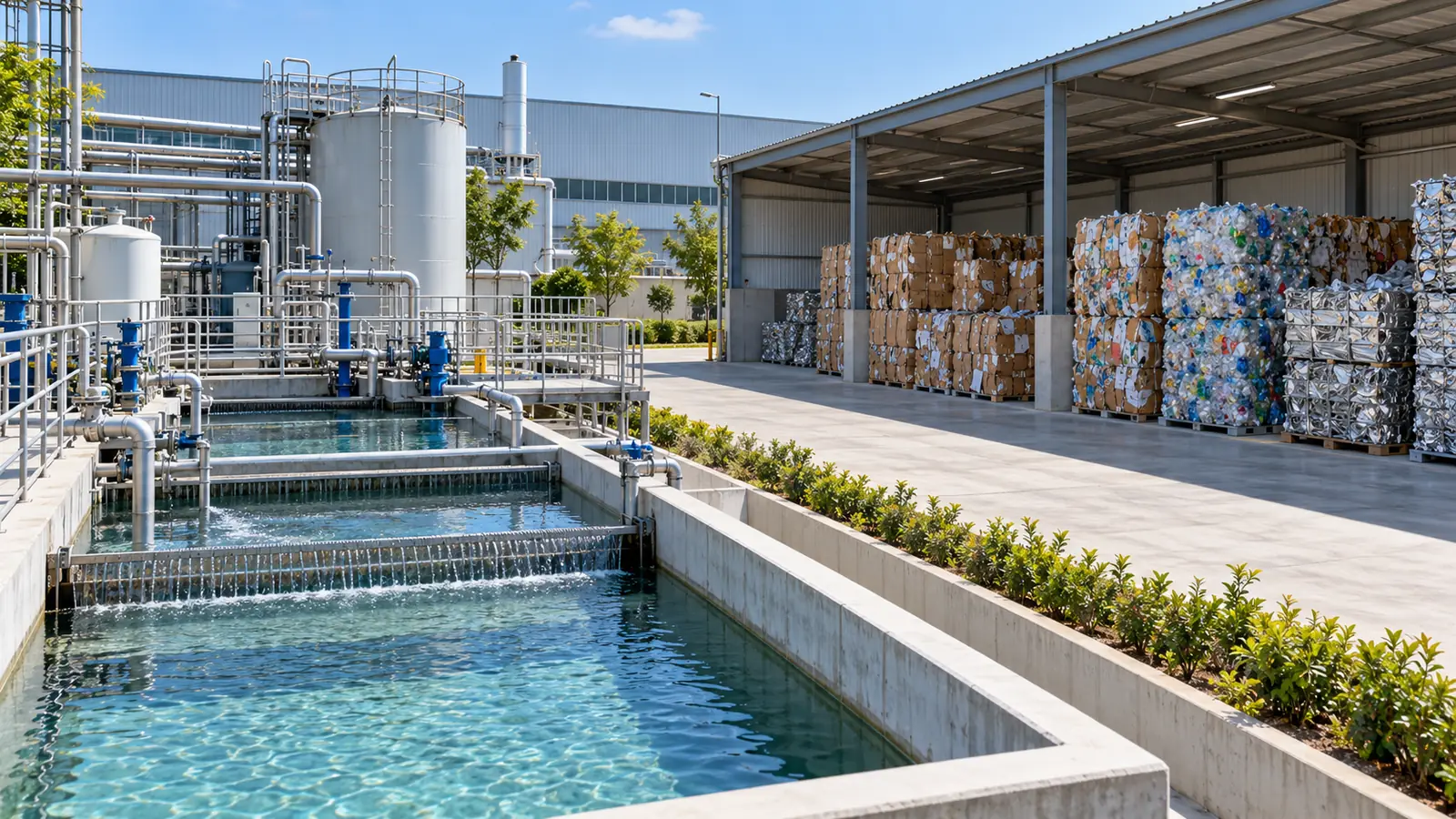
A green factory treats its outputs as resources where possible. Solid waste and scrap can be sorted and reprocessed into material or fuel; wastewater can be treated for safe discharge or reuse in the plant; and exhaust gases can be controlled to meet local limits. Reusing treated water also directly reduces fresh-water intake.
The right route depends on what the plant actually discharges, so start with waste and wastewater analysis. See Environmental Recycling and Difficult Industrial Wastewater.
| Step | What it means | Buyer question | What it does not prove |
|---|---|---|---|
| Production line upgrade | Retrofit or replace inefficient equipment and bottlenecks | What is the energy and water use per unit before and after? | Savings outside the upgraded equipment |
| Clean energy | Solar, storage and waste-heat recovery supplying part of the load | How much of my real load profile can it cover? | That all power comes from clean sources |
| Central control | Monitoring of production, logistics, water, power and gas | Which areas and machines will be metered? | Savings by itself — people must act on the data |
| Waste & wastewater | Recovery, reuse and treatment of what leaves the plant | What is in my waste and wastewater today? | Compliance without testing against local limits |
Where should an old factory start?
Start with a baseline audit. Measure energy, water, gas and compressed-air use by area; list the main waste and wastewater streams; and identify production bottlenecks and frequent stoppages. Two to four weeks of metered data usually shows where the largest losses are and which step will pay back first.
The steps do not have to happen in this order or at the same time. Many plants start with central metering and quick efficiency fixes, then add solar, line upgrades and waste treatment in phases that fit production schedules and budget.
How do I prove the savings?
Agree the baseline before any work starts: which meters, which period, which production volume and which products. After the upgrade, measure the same points under comparable production and adjust for output differences. Savings are then reported per unit of product, not only as total consumption.
Our 25% target for electricity and water applies to the scope we upgrade and is confirmed this way — against the agreed baseline, on the plant's own meters. The achievable figure for a specific plant depends on its starting condition, so it is set after the baseline audit and written into the project scope.
What should you ask your supplier?
- What baseline will you measure, and for how long, before any work starts?
- Which savings target do you commit to, for which scope, and how will it be verified?
- Which equipment will be retrofitted and which replaced — and why?
- How much of our real load profile can solar and storage cover?
- Which meters and data will the central control system include?
- What happens to our waste, wastewater and emissions, and how will compliance be tested?
- Can the work be phased without stopping production?
- Who is responsible for commissioning, training and acceptance?
Frequently asked questions
Do I have to stop production to upgrade?
Usually not for the whole plant. Most work can be done in phases, with tie-ins scheduled during planned shutdowns, weekends or holiday periods.
Can the upgrade be done in phases?
Yes. Many plants start with metering and quick efficiency measures, then add solar, line upgrades and waste or wastewater treatment as budget and schedules allow.
How is the investment estimated?
From the baseline audit: the measured consumption and losses, the selected measures, site conditions and the agreed scope. A reliable estimate cannot be made from floor area or a single photo.
How much of my power can solar cover?
It depends on available roof or land area, your load profile across shifts, storage, grid conditions and local rules. Your real consumption data is needed to size it.
How do I know the 25% target is met?
It is measured on the plant's own meters against the baseline agreed before the work, for the upgraded scope, and adjusted for production volume.
Ready to see what your plant can save?
Send us your products, capacity, monthly electricity, water and gas use, and your main waste types for a green-factory upgrade assessment.