
Capacity expansion should resolve verified constraints across the whole production system—not simply add a faster machine at one point.

Debottlenecking identifies the real limiting steps in an operating plant and develops a staged solution that improves sustainable output, reliability, yield or flexibility. Work can include production mapping, time studies, material-flow review, utility assessment, equipment modification, automation upgrades and targeted new equipment.
Typical applications
- Output increase in operating process or manufacturing lines
- Reduction of chronic queues, stops and changeover losses
- Expansion with limited building footprint or utility headroom
- Brownfield modernization with controlled production disruption
Main equipment and system architecture
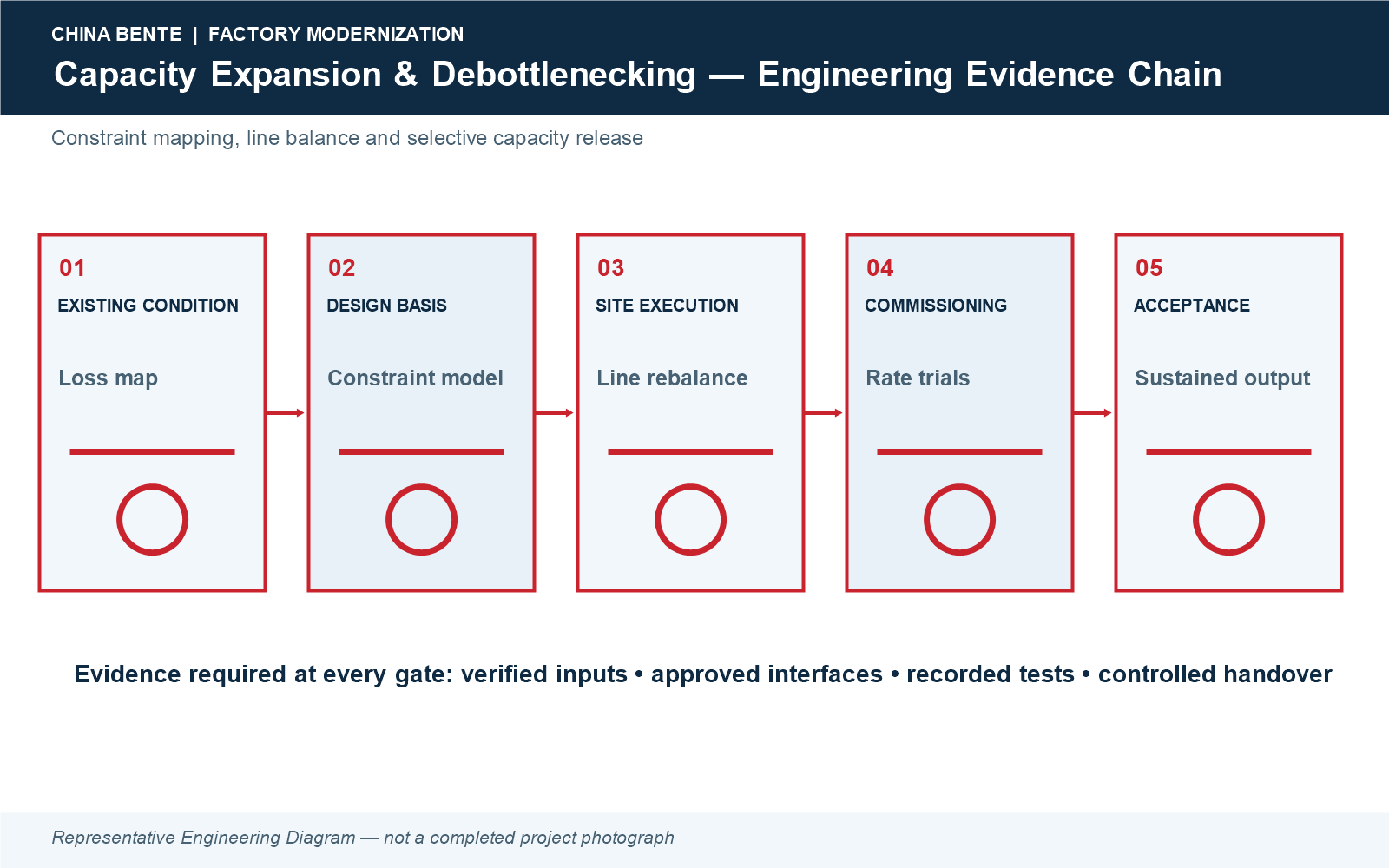
- Production-data capture and operating-time analysis
- Material-flow, buffer and handling modifications
- Targeted equipment upgrade or parallelization
- Utility and control-system reinforcement
- Safety and access improvements
- Commissioning and performance-monitoring tools
Capacity and design basis
Capacity is based on measured run rates, product mix, changeover, uptime, yield, utility constraints, buffer behavior and planned maintenance. A target is defined only after the end-to-end bottleneck is validated.
Utilities and infrastructure
- Electrical load and distribution review
- Compressed air, steam, cooling, water or vacuum checks where relevant
- Network and controls infrastructure for data capture
- Building access, lifting and logistics interfaces
- Temporary utilities or bypass provisions for staged works
Customer engineering inputs
- Production records, product mix, losses and maintenance history
- Current line drawings, P&IDs, layouts and control architecture
- Observed constraints, safety issues and quality concerns
- Site windows for installation and shutdown
- Business objective and acceptance definition
CAPEX and OPEX drivers
CAPEX depends on the selected constraint-removal option, outage plan, integration complexity, civil works and controls. OPEX impacts include energy, maintenance, labor, yield and spare-parts strategy.
Safety, environmental and compliance considerations
The change plan must manage brownfield isolation, machine safety, temporary works, commissioning, contractor interfaces and applicable environmental and occupational requirements.
Outputs and acceptance basis
Acceptance is based on the agreed measurement method, product mix, sustained operating window, quality criteria, safe operation and documented handover; no unverified throughput guarantee is stated.
Related project evidence
No verified capacity-expansion case with directly comparable conditions is currently published on this website. Existing published references are available at Projects & Cases.
Frequently asked questions
What is a bottleneck study?
It is a structured review of the actual limiting constraints across production, material flow, utilities, controls and operating practices.
Can capacity increase without a new building?
Often possible, but it depends on verified footprint, access, utilities, safety separation and the true constraint.
How is production disruption controlled?
The implementation is phased around confirmed shutdown windows, temporary arrangements, isolation procedures and commissioning tests.
Can existing equipment be retained?
Yes where its condition, safety, capacity, controls and maintainability are suitable for the target operating basis.
Why is product mix important?
Different products can shift the limiting step, changeover time, yield and utilities, so a single nominal rate may be misleading.
What data should be collected?
Run rates, stops, changeovers, rejects, maintenance, buffers, energy and utility conditions are typical inputs.
How is success measured?
Using a pre-agreed baseline and verification method for the approved product mix, operating window, quality and safe operation.
Can automation be part of debottlenecking?
Yes, where controls, scheduling, material handling or visibility are verified contributors to the constraint.
Request a Project Evaluation
Share the current asset data, objectives, constraints and available records. China Bente will define a staged engineering basis without assuming unverified values.