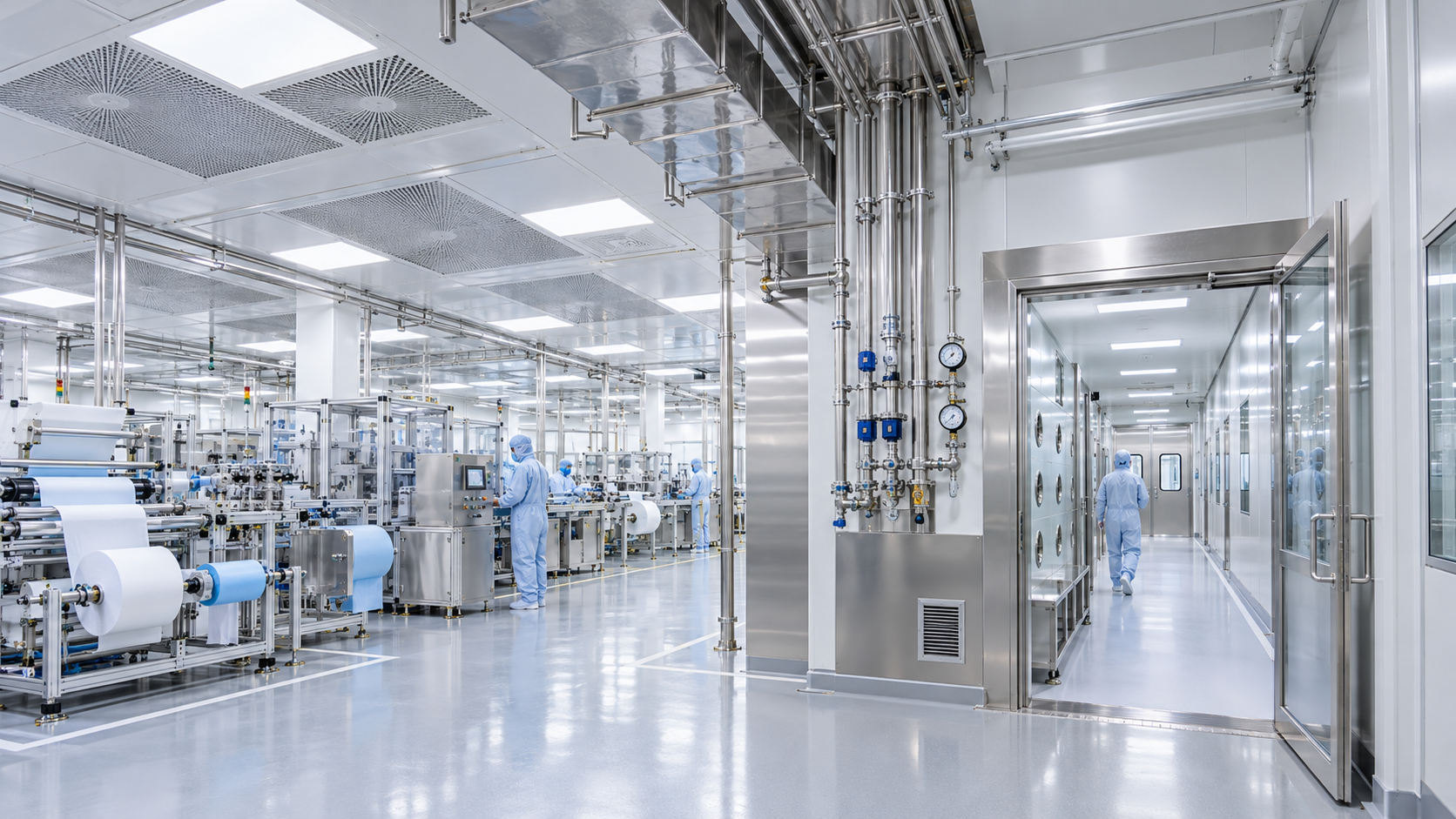
Cleanroom, HVAC and Clean Utilities
Zoned clean production rooms, personnel and material airlocks, HEPA filtration, pressure control, environmental monitoring, clean compressed air and production-utility interfaces.
 CHINA BENTEINDUSTRY GROUP
Integrated clean-manufacturing engineering for disposable syringes, IV bags and other qualified medical-consumable product families.
Preliminary engineering selection range: Disposable medical-device equivalent; exact output depends on product geometry, cavity count, sterilization route and validated OEE. Final guaranteed values are issued only after feed/product data, utilities, site conditions and performance-test criteria are confirmed.
| Plant scale | Typical capacity range | Key technical envelope | Typical configuration |
|---|---|---|---|
| Compact | 30–120 pcs/min | ISO 8 background / ISO 7 critical zones where required | 1 forming or moulding cell + semi-automatic assembly |
| Standard | 120–400 pcs/min | Controlled clean utilities; in-line vision and leak test | Integrated forming, assembly and primary packaging |
| High-output | 400–800+ pcs/min | Redundant utilities and electronic batch records | Parallel cells with automated cartoning/palletizing |
The factory scope can combine cleanroom and HVAC engineering, automated syringe and IV-bag lines, disposable needle assembly, gauze and bandage converting, quality-control laboratories, clean utilities, packaging and production traceability.
Zoned clean production rooms, personnel and material airlocks, HEPA filtration, pressure control, environmental monitoring, clean compressed air and production-utility interfaces.
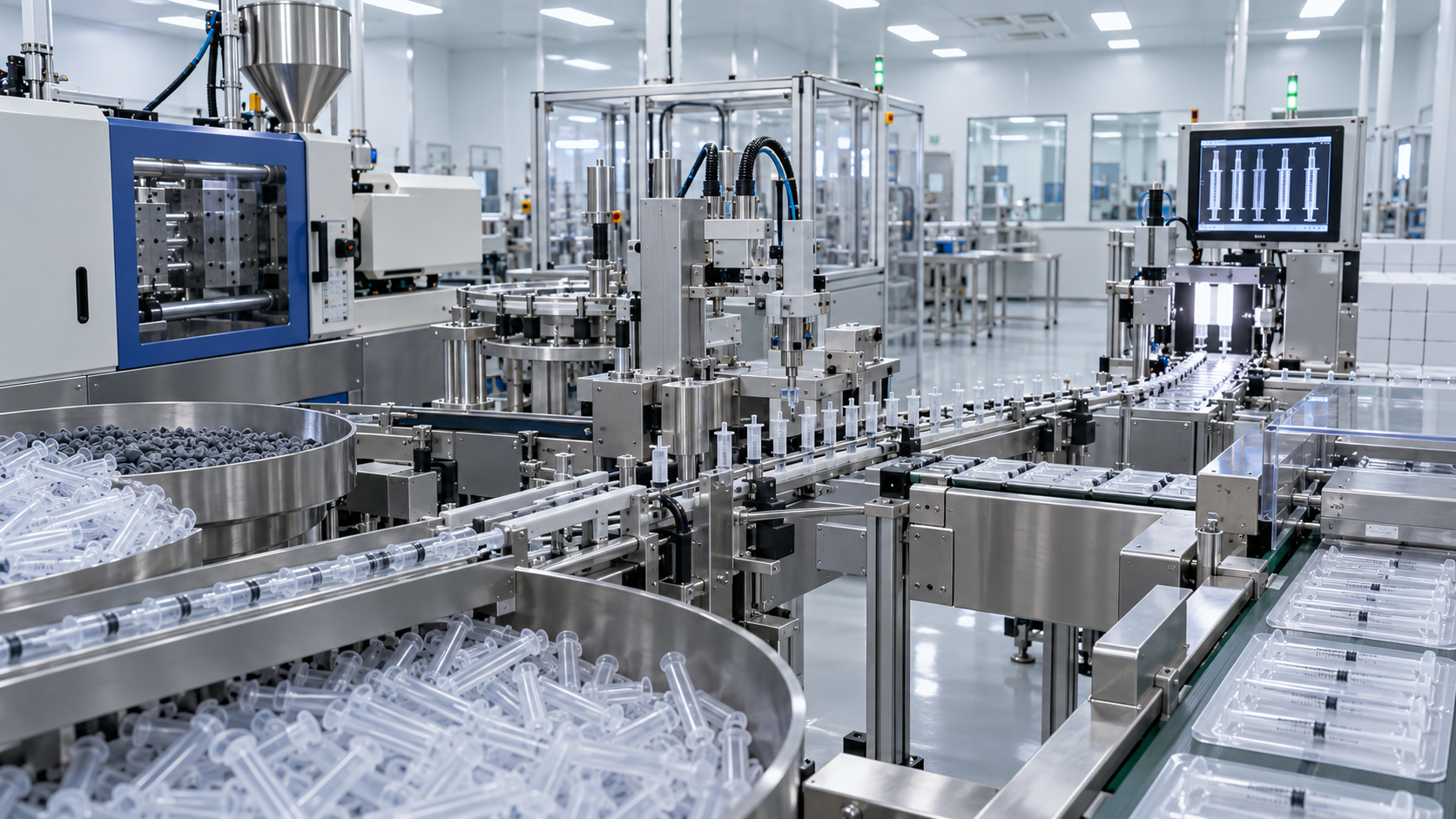
Medical-grade molding, component feeding, barrel printing, automated assembly, inspection, primary packaging and downstream sterilization interfaces.
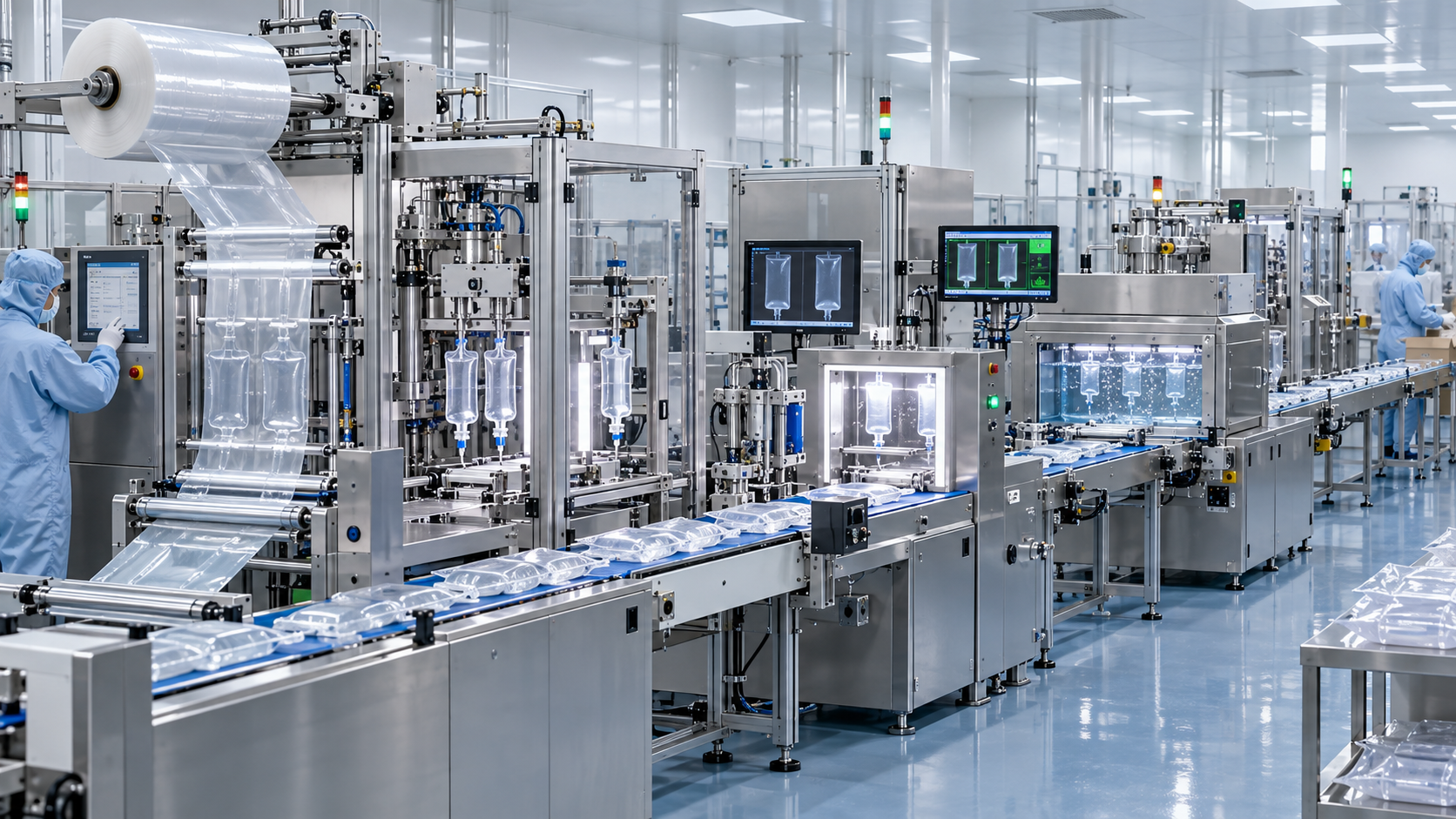
Medical-film handling, bag forming, port insertion, precision sealing, leak and vision inspection, controlled transfer and clean packaging.
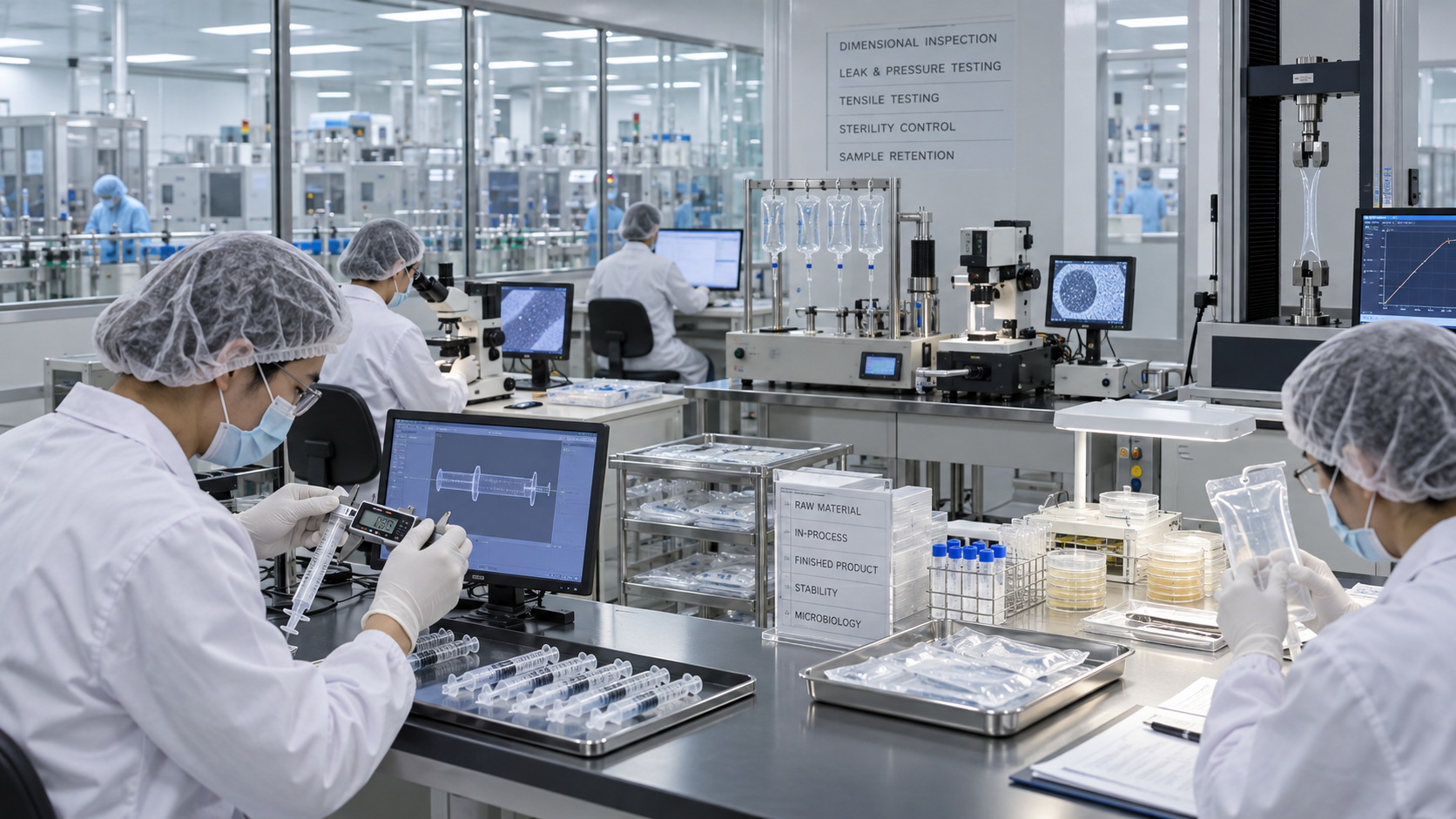
Incoming, in-process and finished-product inspection with dimensional, tensile, leak, pressure, functional, microbiological and sample-retention areas as required.
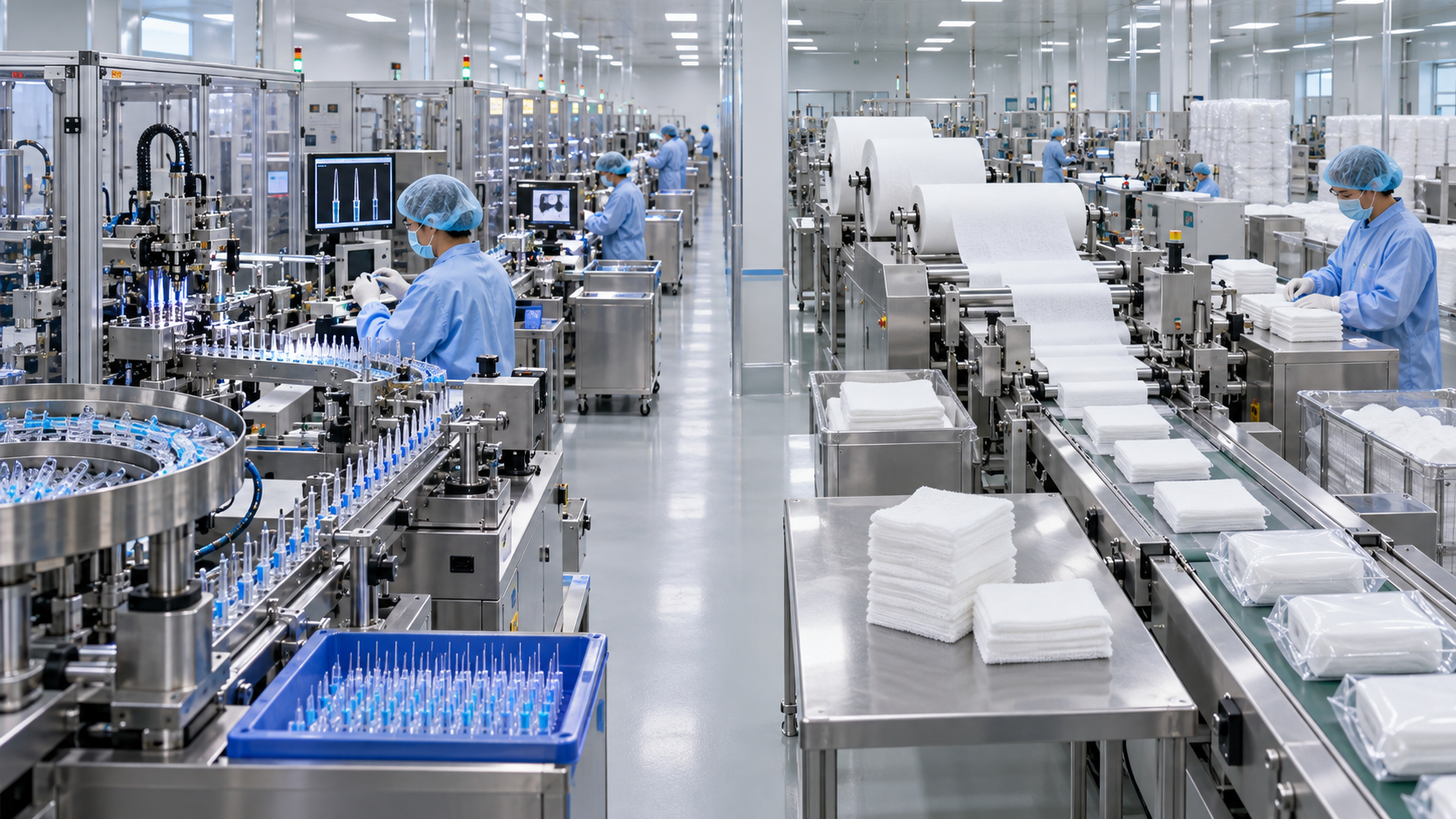
Needle-component assembly and inspection alongside gauze, nonwoven and bandage converting, cutting, folding, counting and packaging systems.
Raw-material control → clean transfer → molding / forming / converting → automated assembly → in-process inspection → primary packaging → sterilization interface → laboratory release → secondary packing and dispatch.
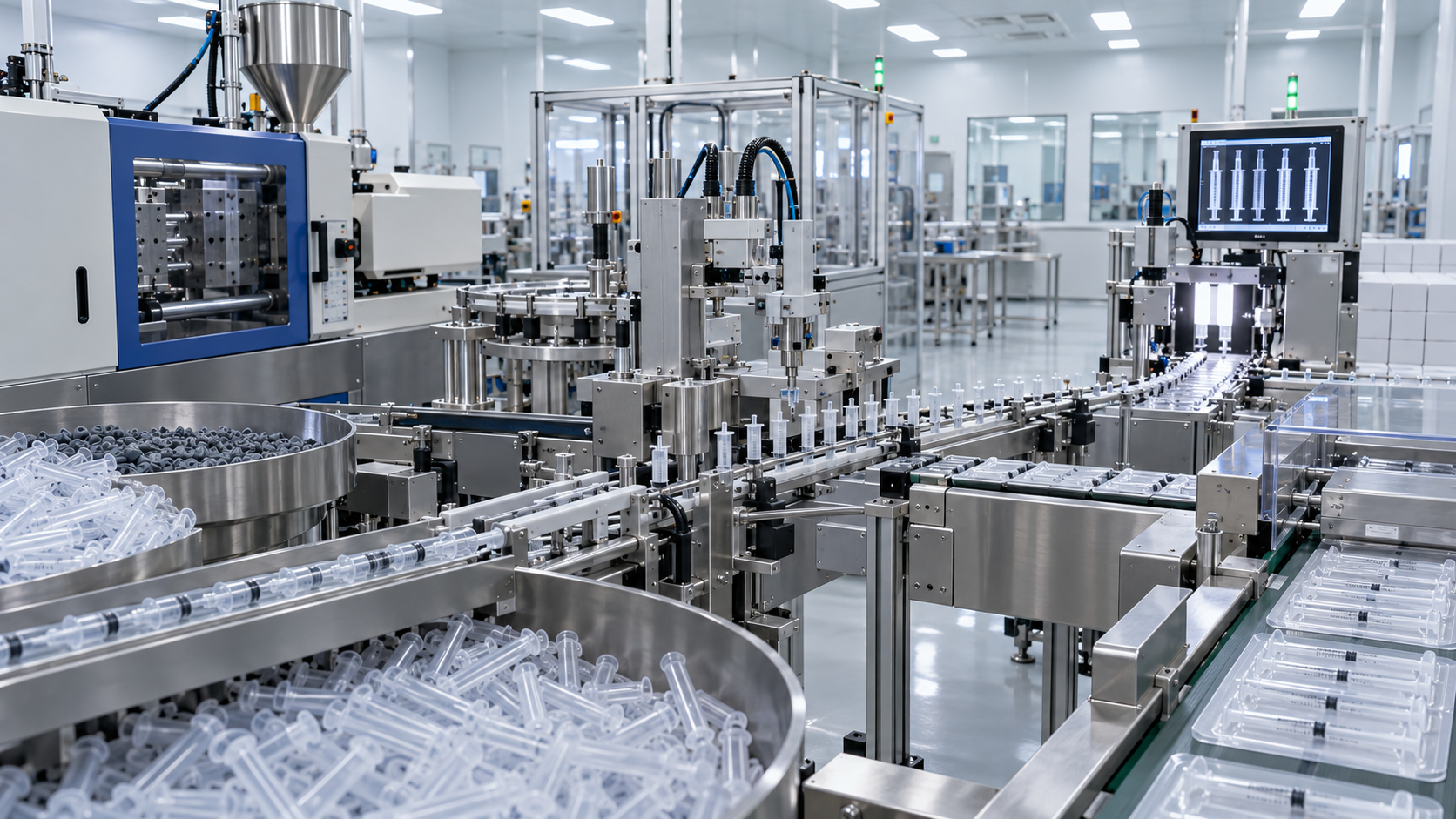
Integrated clean-manufacturing engineering for disposable syringes, IV bags and other qualified medical-consumable product families.
A product-specific manufacturing facility integrating clean zoning, production lines, inspection, packaging, utilities, HVAC and qualification support.
Approved polymers, components, packaging materials and product specifications, with regulatory class, cleanroom needs and sterilization boundary confirmed by the client.
Product drawings, materials, process validation plan, cleanroom zoning, particle and microbiological criteria, HVAC loads, utility quality, packaging and sterilization interfaces.
Power distribution, water, steam or thermal energy, cooling, compressed air, industrial gases, drainage, fire protection, buildings, roads, storage and maintenance access are sized from the verified design basis.
Clean exhaust, VOC or EO interfaces where applicable, rejected polymer handling, wastewater, HVAC energy, pressure control and occupational safety are engineered by process. Relevant interfaces are coordinated with Turnkey Factory EPC · Waste Recycling · Difficult Wastewater · Renewable Energy · SMART Solutions.
Feed variability, process route, throughput, materials of construction, energy demand, emissions limits, automation, redundancy, local construction, logistics and product acceptance criteria drive lifecycle cost.
Products, cleanroom conditions and utilities are accepted against agreed specifications and FAT, SAT, IQ and OQ support boundaries. No capacity, yield, quality or certification is assumed until supported by testing and an agreed design basis.
Representative samples and analyses, target products, operating schedule, site survey, climate, utility data, applicable codes, discharge limits, plot plan, logistics and acceptance protocol.
Concept definition, feasibility, process and layout engineering, equipment selection, procurement, civil and construction interfaces, utilities, automation, environmental systems, installation support, FAT/SAT, commissioning, training, trial operation and lifecycle service can be included within the agreed boundary.
Tooling, barrel geometry, component feeding, printing, inspection and packaging determine the validated size range; it is not assumed.
The scope can include film handling, forming, port insertion, filling, sealing, leak testing, inspection, packaging and clean utilities.
Infusion sets, blood collection tubes and sets, IV cannulas or catheters, medical tubing, urine or drainage bags, masks, caps, gowns and disposable medical packaging can be evaluated separately.
It follows the product, process exposure, regulatory strategy, risk assessment and client validation basis; no class is assumed in advance.
Zoning, AHUs, HEPA filtration, temperature, humidity, pressure gradients, air-change strategy, airflow, exhaust and monitoring can be included.
Personnel airlocks, material airlocks, pass boxes, gowning, waste exits and directional flows are arranged from contamination-risk analysis.
No. Their need and quality follow product and process requirements, and the generation and distribution boundary is confirmed project by project.
Yes. Differential pressure, temperature, humidity, particle or other agreed parameters can be monitored, alarmed and historically recorded.
Load calculations, production criticality, maintenance strategy, climate and recovery requirements define redundancy and standby philosophy.
The agreed scope can include design documentation, FAT, SAT and support for IQ and OQ; regulatory approval remains with the responsible manufacturer and authorities.
Cycle tests, equipment configuration, product mix, changeover, yield assumptions and operating hours establish the design basis.
Provide product specifications, materials, target volumes, packaging, cleanroom and regulatory basis, site data, utilities and validation expectations.